Story by Matthew Stace, Guest Editor
Almost all of Catholic ecclesiology hinges on one crucial fact: the Church is the body of Christ. It’s a fact that Catholics often hear in the form of an empty platitude with vague notions of dignity. However, it is as serious a reality as any doctrine or dogma. Though it is explicitly laid out in the Bible, people may be in the habit of thinking it to be a modern rediscovery of a fact once lost to Christians everywhere, but this would be a mistake. In fact, this has historically been a fundamental notion in the Church’s understanding of itself. So much so that at the climax of the Middle Ages, Pope Boniface VIII found it necessary to explain the doctrine and its implications in Unam Sanctam, a document whose proclamation dogmatically defined the Church’s notion of its own nature.
So what does this actually mean? St. Paul says that Christ “…has put all things under His feet and has made Him the head over all things for the Church, which is His body, the fullness of Him who fills all in all,” (Ephesians 1:22-23). Boniface VIII elaborates that the Church “represents one sole mystical body whose Head is Christ and the head of Christ is God [1 Cor 11:3]” and compares the Church’s union with God to that of a spousal relationship, being of one flesh. This not only denotes the unique relationship of the Church to Christ but gets at the heart of her nature. Whatever can be said of Christ can, in a certain sense, be said of the Church. Christ possesses both a human and divine nature and has “all authority in heaven and on earth,” (Matthew 28:18). So the Church is of a divine nature made up of humans who, though imperfect now, will either be made perfect or rejected on the last day. The Church speaks today with the voice of Christ, so when one asks where Christ said something, one can point to the Church, for Christ said of His Church that “he who hears you hears Me, and he who rejects you rejects Me, and he who rejects Me rejects Him who sent me,” (Luke 10:16). Christ remains with us, and so does His authority. However authority is but one example of this principle, and so the matter demands further exploration and meditation that will bear much fruit.

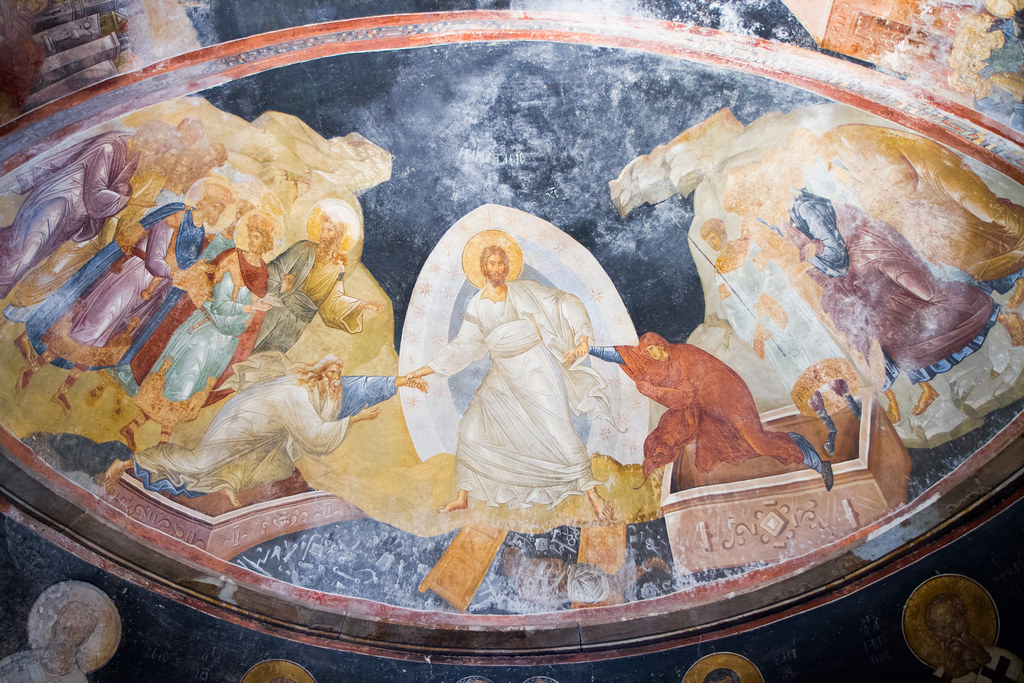
Photo courtesy of Wiki Commons


 The Saint
Leave a comment