By: MAGGIE PRINA
Dancing is arguably one of the most physically demanding sports out there. Not only are you required to perform impressive feats of flexibility and dexterity, but you must also be coordinated and in time with your fellow teammates.
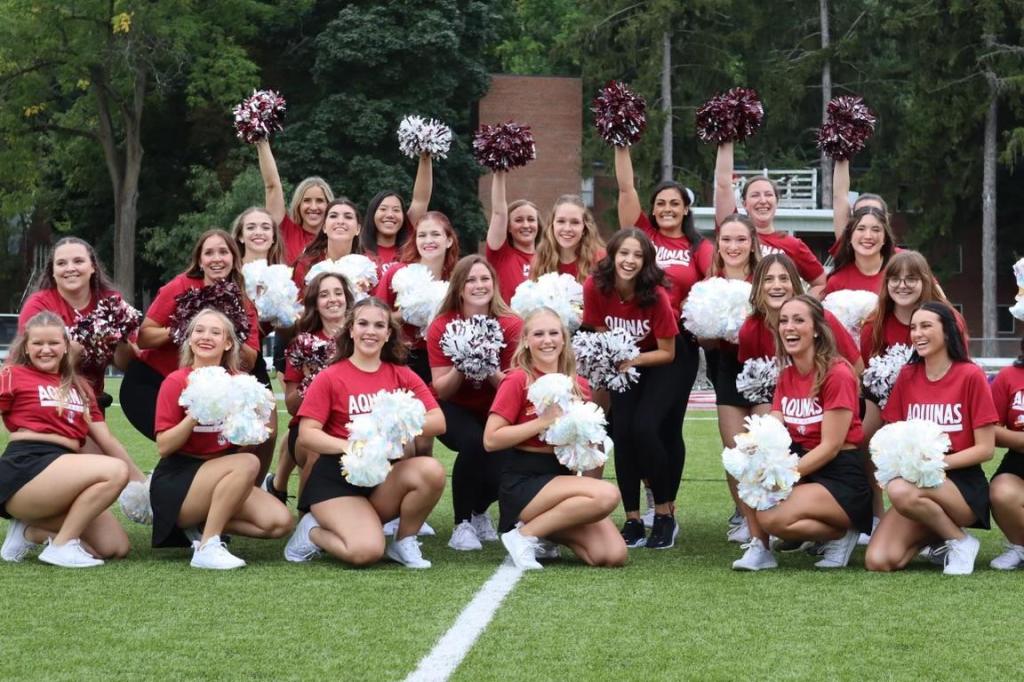
The team consists of Jaidyn Alemany, Bella Angebrandt, Zoebelle Bean, Alana Calhoun, Margaret Christian, Emma Daling, Mallory Huhn, Aijamal Kasymova, Ava Koester, Delany Lovely, Sophia Lugtigheid, Grace Malec, Charla Sheofsky, Amelia Thurm, Olivia White and Ellie Wieber.
The Aquinas Dance Team has worked incredibly hard this year to live up to the standard they set in 2022 — bringing home 1st place five times, as well as winning 2nd at the NDA College Nationals. Training this year has been rigorous, and has included a weekend dance camp, where the team danced over 20 hours in the course of just two days, learned five new routines, and grew even closer as a team. The hard work paid off, as the team has qualified for NDA College Nationals again this year.
Ava Koester, a freshman who joined the dance team this year, described the environment: “[It’s] positive and uplifting. Everyone is so encouraging and we all push and challenge each other to be the best we can be,” Koester said. Mallory Huhn, a sophomore on the team, echoed a similar sentiment. “I would say [the environment] is positive, everybody wants to help everyone be at the highest level they can be, and are always there to help, support, and lift each other up,” Huhn said. Especially in a competitive team setting, communication and a good attitude are key. The people you are dancing with are the people that you are going to see the most all year, and they end up becoming like a second family to some of the teammates. Whether at a game or during practices, teamwork is crucial to the success of the group.
Practice for the dance team is around 2 hours long, and involves different exercises and team building activities. “A typical practice begins with stretching, and then we work on whatever routine we are learning at that time. We often split into small groups to critique each other and receive individual feedback,” Koester said. “A practice consists of a lot of cleaning, which is going through a dance routine count by count to make sure everybody is in sync,” Huhn said. Outside of practices, students additionally go to the gym to keep in shape and warmed up for further workout.
Dancing is not for the faint of heart. It not only requires physical stamina and flexibility, but the ability and coordination to be in sync with teammates. Although on first glance dancing might not seem like a very physically intense sport, athletes spend many hours each week perfecting a routine and exercising. “I would say [the hardest part about dancing is] the toll it takes on your body, but also the struggle of getting taken seriously or recognized as a sport.” Huhn said. Sometimes it is hard for people to look past the glitter and the pom poms and realize all of the work and energy that goes into a dance routine. When you think of the word “sport,” people rarely would think of dancing first, and some may not even consider it to be a sport. However, the work, time, energy, and overall athleticism that is required to effectively pull a dance routine together proves otherwise.

Photos courtesy of Ava Koester
Without motivation and inspiration, the team would never improve. Not only are the girls pushed to do better for each other and the benefit of the team, but for themselves. Self betterment and improvement is key to a healthy and competitive team environment. “For me, the most rewarding part about being a dancer is when I get to see my hard work paying off by achieving a new trick or skill,” Koester said.
“Something that motivates me is not only performing the best I can for myself, but performing the best I can for the benefit of the whole team. We’re also a team who tends to work very hard to perform the best we can and win when we can,” Huhn said. She is currently out for the season due to injury, but still comes to practices to support her team, give encouragement, and be there for her fellow teammates even when she can’t dance.
The dance team so far has performed for the West Michigan Whitecaps, Project Night Lights near the Helen DeVos Children’s Hospital, and many other on campus events, such as the homecoming game, 90’s night, Saints Slam, men’s and women’s basketball games, and others. The AQ dance team has been an inspiration to many young girls, especially at Project Night Lights, where they let children hold their pom poms and dance with them. We hope to see more beautifully choreographed routines in the future, and we can’t wait to see how they perform at the NDA College Nationals this year.


 The Saint
Leave a comment