
Story by Mark Musgrave III, Editor-In-Chief
From February 8 to February 27 the Student Senate conducted a survey to collect data on current student opinion of the block model currently being piloted. Despite many scattered opinions from students, faculty and staff across the board, the overwhelming majority of students voted NO on the survey by a vote of 334 to 36 when asked the question: “Based off your current understanding of the block model, would you support an eventual transition to the block schedule at Aquinas?” The ratio of student athletes who took the survey was 232-138, and the most participating students in the survey based on area of study were STEM, Business, Education and Philosophy. Current released data from the survey can be viewed on the Student Senate Instagram, with a more complete set of data to be released at a later date.
The results of the survey were a shock to some faculty, as they made the claim that some students were “uninformed” on the block model and unaware of the full scale of the idea. There is some weight to that claim, as few students are aware that other models are being discussed by administration at this time. “The block model has been around for 50 years, the fact that four schools in the country have it is worth considering when moving forward.” said Accounting Professor Kevin Cantley.
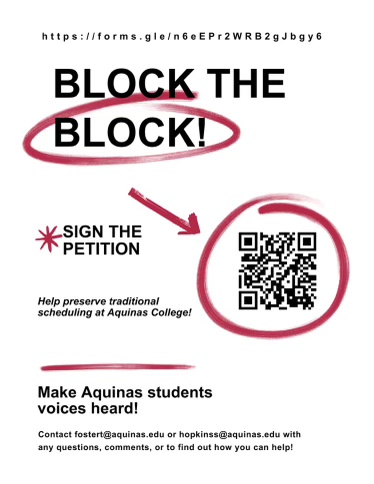
Two sophomore students Scott Hopkins and Tess Foster are compiling a petition to “Block the Block” from being implemented. Here is what Tess had to say:
“I am organizing a petition and gathering signatures to advocate for the preservation of traditional scheduling at Aquinas,” said Foster. “If needed, I will also organize a student protest to halt the transition to the block model of scheduling. As current AQ students, we feel that our voices are not being heard. Through reaching out to faculty and collecting signatures, we are trying to make our voices heard and valued. Students can sign the petition by using that QR code. Any questions or comments, can be directed to me at fostert@aquinas.edu.”
Q: Are you aware that other more feasible models are being discussed?
“Yes, we do not want any form of the block model. We want the traditional model preserved. We do not care if certain students who chose to do so participate in the block, but we do not want to all be forced into it.”
The Faculty will vote on some kind of transition to a block model on April 27.



 The Saint