Article by Joel Grimsley, Arts Editor
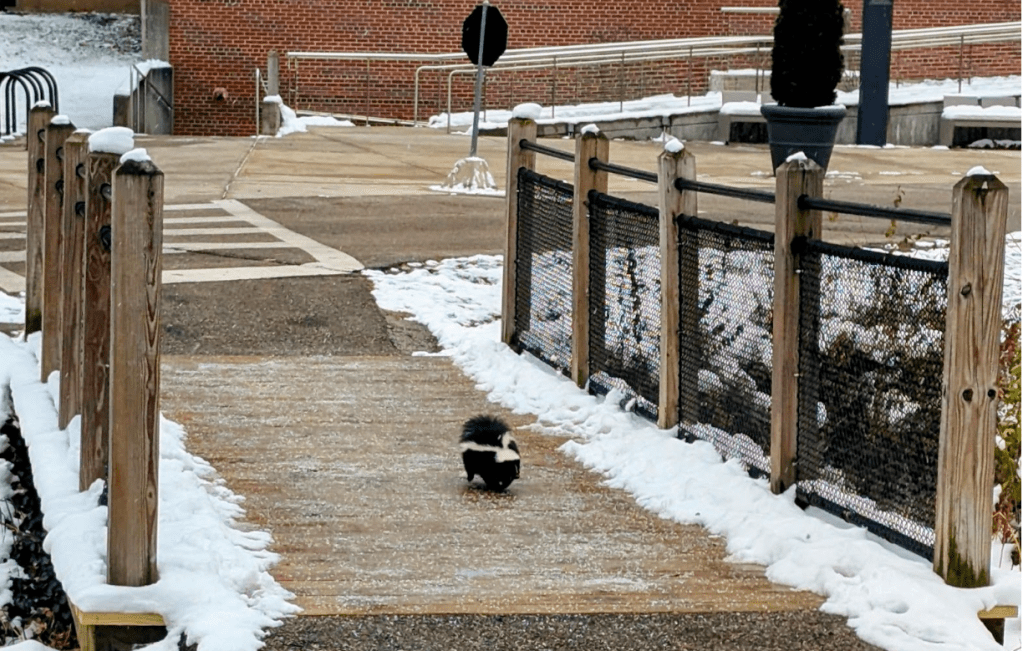
While studying for finals, students on Aquinas College campus have had encounters with a skunk in broad daylight the week of Dec. 2-6.
The skunk, presumably the same one, which a few students have named Odis, has been scampering around campus. Surprising many students and causing a commotion.
Reported daytime sightings of the infamous monochrome mammal range from the chapel, the path to St Joseph’s and Albertus. The skunk has even been spotted outside the Moose, an area with heavy foot traffic.
While not uncommon in Michigan, skunks are usually nocturnal creatures, making these appearances particularly curious. Skunks typically spend the day sleeping in their dens and exit in the evening to search for food. However, if necessary, they may venture out during the day to search for food if competition is high at night, or when their resting spot has been disturbed.
Whilst skunks do not hibernate, they enter a deep sleep within winter months where their body temperature drops as low as 20 degrees, causing their metabolism to slow. Skunks typically settle into their dens from November to March, again highlighting the peculiarity of the skunks’ repeated cameos.
The reception of students spotting the skunk during daylight hours has been mostly positive, such as from sophomore Lexi Nutter. “I was super excited to see the skunk, my roommate who worked for campus safety in the early mornings last year said she saw it all the time” said Nutter. “I saw him the other day, his little waddle through the snow was absolutely adorable.” She also added her concern about the possibility that something was wrong with the skunk for it to be out during the day. “This odd behavior may be the result of some sort of illness or disease.”
For others such as sophomore Kyle Devine the skunk highlights the biodiversity of campus: “I think it’s cool, the fact we have a great variety of animals, it just speaks out on how cool this place is.”
Devine also pointed out that It’s not the first time the skunk has been seen on campus, it just is startling that it is making repeated bold appearances during the day.
The enthusiasm to see the college’s black and white friend should be paired with caution, skunks are infamous for their stink, and the stinky fluid they can spray. This fluid that skunks project is emitted as a fine spray or stream, and has a range of over 10 feet.
It is advised when students encounter the skunk, to stand still, keep their distance and slowly back away. Skunks will only spray as a last resort and will give threats plenty of space and a warning if it intends to defend itself. A warning that they are about to spray is when they arch their backs and raise their tails, and then if they turn their back to the target, they are most likely about to spray.
“It’s adorable,” said Devine, “but I don’t want to get sprayed, I’ll keep my distance.” A strategy that all students should consider if encountering a skunk in order to avoid a bad smell.

‘Odis’ scampering around outside the Moose – Photo by Hannah Bechtold




 The Saint