By Yashowanto Ghosh, Aquinas Reporter
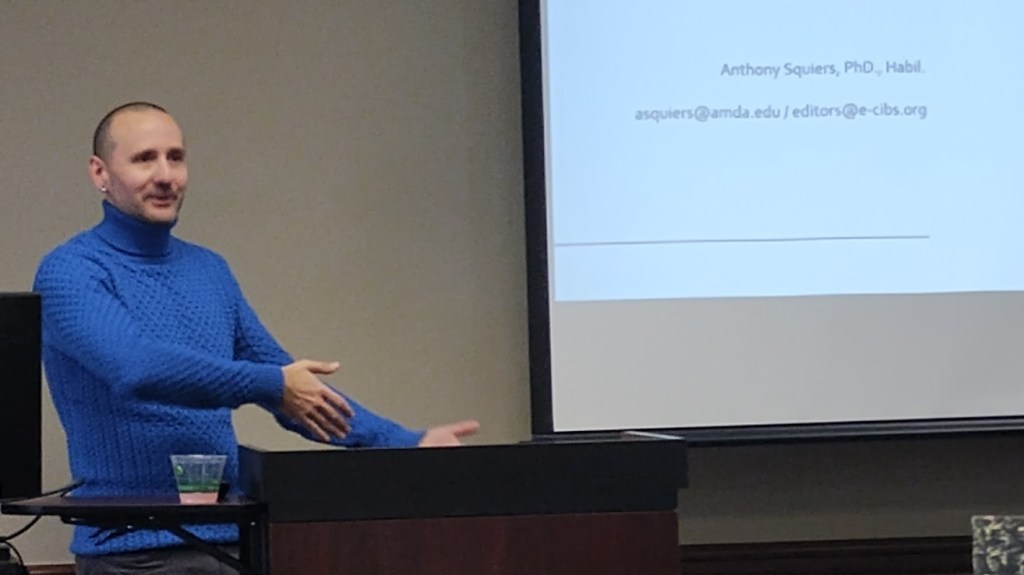
Aquinas College alumnus Anthony Squiers, Ph.D., lectured about his brand new book, Bertolt Brecht’s Adaptations and Anti-capitalist Aesthetics Today, in the Loutit Room of the Wege Center at noon on Wednesday, March 5, 2025.
Squiers majored in political science—Professor Roger Durham said Squiers was on Aquinas College’s first ever Model United Nations team, which travelled to Kent State University for the conference, where it won third place. Now Squiers is on the faculty of the American Musical and Dramatic Academy’s College of Performing Arts. The new book is the fourth book he has written.
The book’s subject, Bertolt Brecht, was a leading theatre artist of the twentieth century. Squiers said Brecht is the second most often produced playwright in the world, behind only Shakespeare. He added that, beyond writing plays, Brecht is important for his extensive contributions to the theory of theatre, such as his conception of epic theatre. The book focuses on a third part of Brecht’s work: his adaptations of the work of other artists. His Die Dreigroschenoper, which was the biggest hit show of the Berlin stage of the 1920s, was a German-language adaptation of an English play from 200 years before; he also adapted classics of world theatre by such playwrights as Sophocles, Shakespeare, and Molière. Squiers said he decided to study Brecht’s adaptations because they constitute a very sizeable body of work, and yet they have not attracted much attention from researchers up to now.
In the book, Squiers formulates a hypothesis about a process Brecht may have followed for making adaptations. The hypothesis is constructed using concepts explicitly available in Brecht’s own writings on the theory of theatre. Then the book chooses four of Brecht’s adaptations and proceeds to check how well the hypothesized process fits those four works; Squiers said he chose two adaptations of older playscripts to new playscripts, one adaptation of a Platonic dialogue to a short story, and one adaptation of newspaper clippings to an art book.
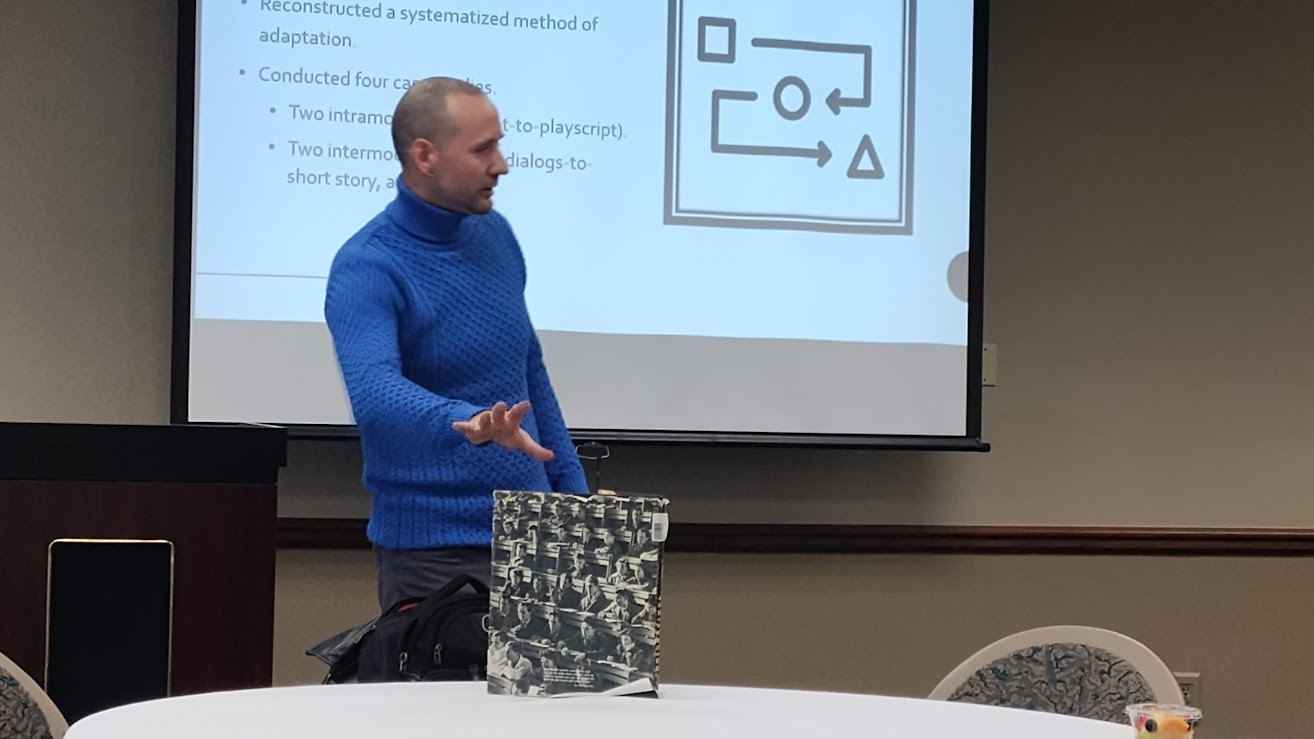
Squiers explaining the process he says Brecht might have followed; the book standing up on the table in front is a copy of Brecht’s art book Kriegsfibel- Photo by Yashowanto Ghosh/The Saint
The lecture concluded with a more detailed look at Brecht’s art book Kriegsfibel, the last of the four adaptations analyzed by Squiers in his book. Squiers said the title, Kriegsfibel, translates to “war primer;” it is based on newspaper clippings Brecht collected during his 15 years of exile from Nazi-era Germany, such as a photo of German army vehicles rolling into Poland, or a photo of Hitler. Each clipping is accompanied by a quatrain Brecht wrote about it; some of the clippings also have a separate caption for context. The lecture was attended by an audience of over 20 people. With its topic intersecting multiple disciplines, it attracted students of theatre, German, history, and political science, and the question-and-answer session at the end also addressed Brecht’s biography, including the years he spent in the United States of America.
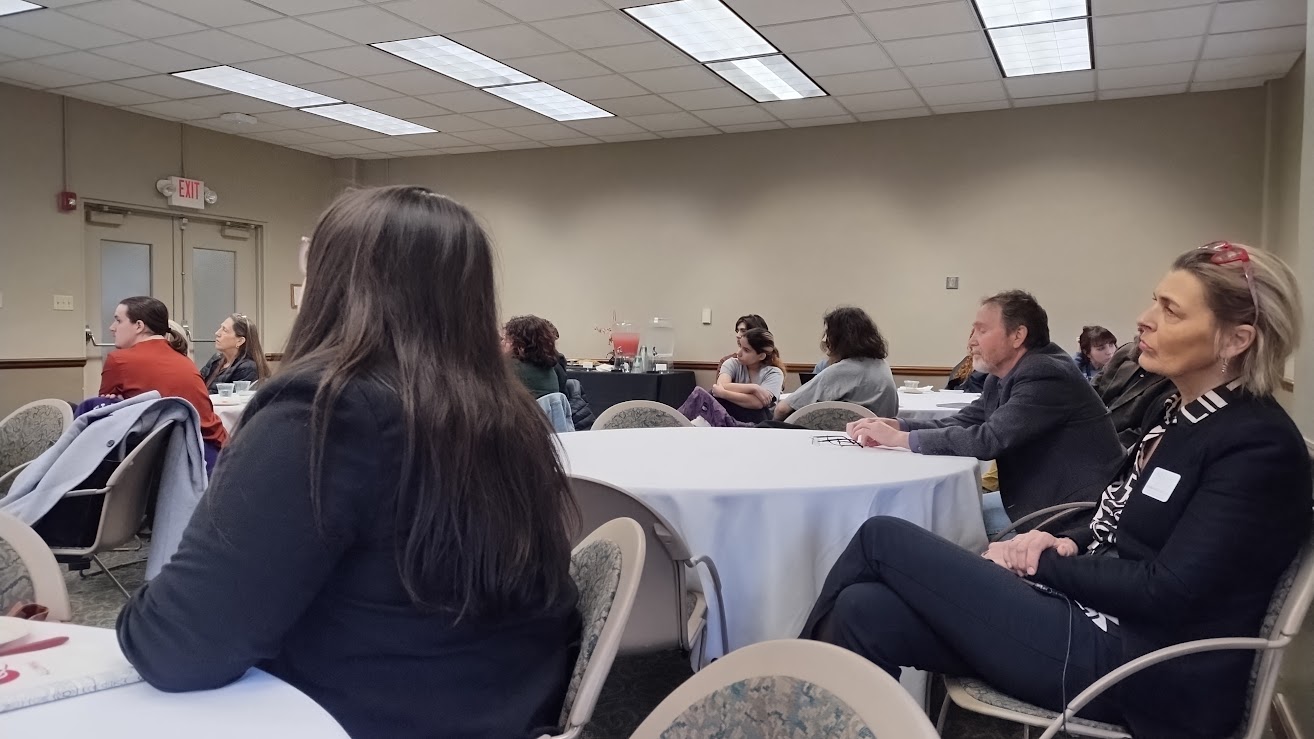
The audience at the talk. Photo Yashowanto Ghosh/The Saint


 The Saint