By Makayla Casarez, Reporter

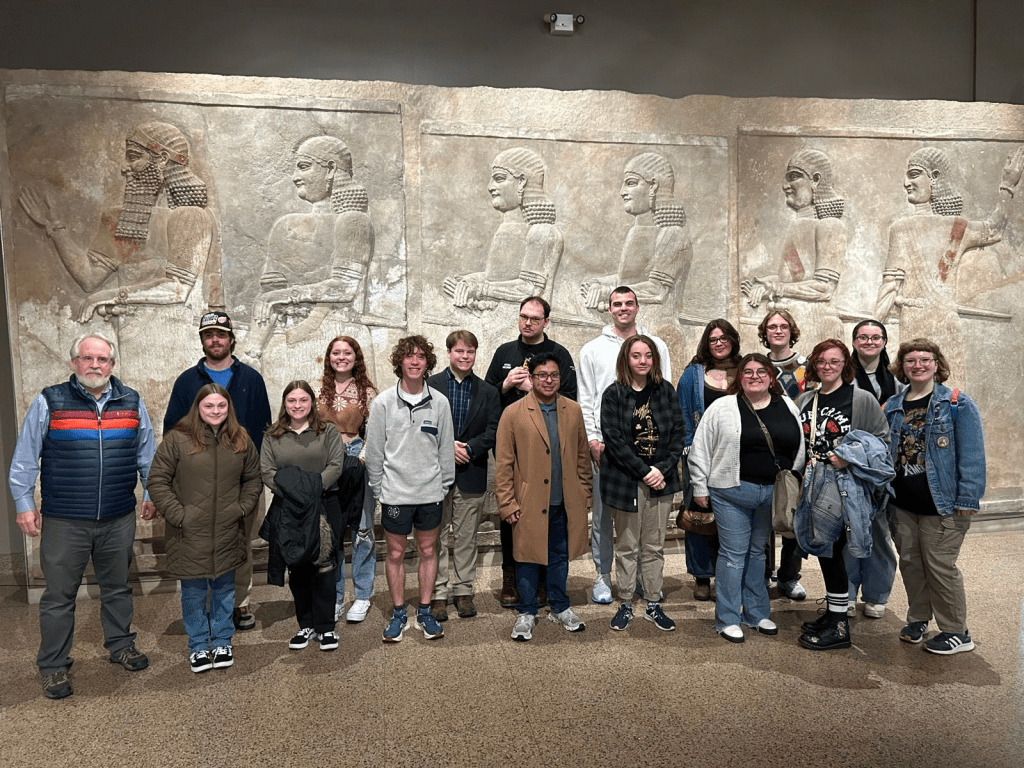
History club members at the ISAC – Photo by Chad Gunnoe
On March 21, 2025, the Aquinas College Art Department and History Club took a trip to Chicago Illinois. The trip to Chicago was arranged by Professor and Gallery Director Dana Freeman and Professor and History Department Chair and Director of Irish Studies Chad Gunnoe, from the art department and history departments respectively. Freeman and Gunnoe planned and funded the trip through a NetVue grant. The itinerary was planned for the Art Department students who attended the Chicago Institute of Art, while the Aquinas College History Club participants visited the University of Chicago’s Institute for the Study of Ancient Cultures (ISAC), followed by the Field Museum.
“It’s really quite a privilege, quite an asset that we’re able to drive this far and go down to see such world class institutions,” said Gunnoe. “[the University of Chicago] played a fundamental role in the development of ancient Near Eastern Archaeology, and the study of Ancient Near Eastern languages, including Acadian and Sumerian.”

Institute for the Study of Ancient Cultures is located on the campus of the University of Chicago – Photo by Joel Grimsley
Upon the arrival of the History Club participants to the University of Chicago’s museum, the group took a picture and went through self-guided tours through the exhibits. The ISAC tour opened with an introduction to the Ancient Near East with The Edgar and Deborah Jannotta Mesopotamian Gallery.

Odin, the AQ Writing Center Otter and History Club Participant studying Mesopotamian Artifacts at ISAC – Photo by Makayla Casarez
The Edgar and Deborah Jannotta Mesopotamian Gallery blends seamlessly into The Yelda Khorsabad Court which is a recreation of a piece of the interior courtyard of the Assyrian King Sargon II. The Yelda Khorsabad Court contains relief panels from the royal palace of king Sargon II, framing the massive relief of the Lamassu, a human-headed bull from Assyrian mythology, among many other artifacts.

Odin, the AQ Writing Center Otter and History Club Participant Observing the Lamassu Relief at ISAC – Photo by Makayla Casarez
The following exhibit, the Assyrian Empire Gallery, consisted of artifacts, including, but not limited to statues, steles, and reliefs from the Assyrian Empire. The artifacts and reliefs from the The Assyrian Empire Gallery along with the Yelda Khorsabad Court were excavated during the ISAC Iraq Expedition that was held from 1929-1935 centered around the area of the royal palace of Sargon, and other excavations at Nippur in Southern Iraq, and Tell Fakhariyah in Syria.
The succeeding exhibit, The Henrietta Herbolsheimer, M.D. Syro-Anatolian Gallery, which includes artifacts from cultures from Turkey and Syria beginning in the Neolithic period. The exhibit includes ceramics, tools, metalwork, luxury goods, and many other artifacts. The Haas and Schwartz Megiddo Gallery centers around the city of Meggido and artifacts from the ISAC Meggido expedition from 1925-1939. The Joseph and Mary Grimshaw Egyptian Gallery includes the Colossal Statue of King Tutankhamun, c. 1334 BCE, as well as several other artifacts, including recreations of the Rosetta Stone and a copy of the Bust of Nefertiti.
“I really liked when they talked about the replication process and how they made the eyes different so that they could test out different materials.” said senior Lindsey Harvell of the copy of the Bust of Nefertiti.
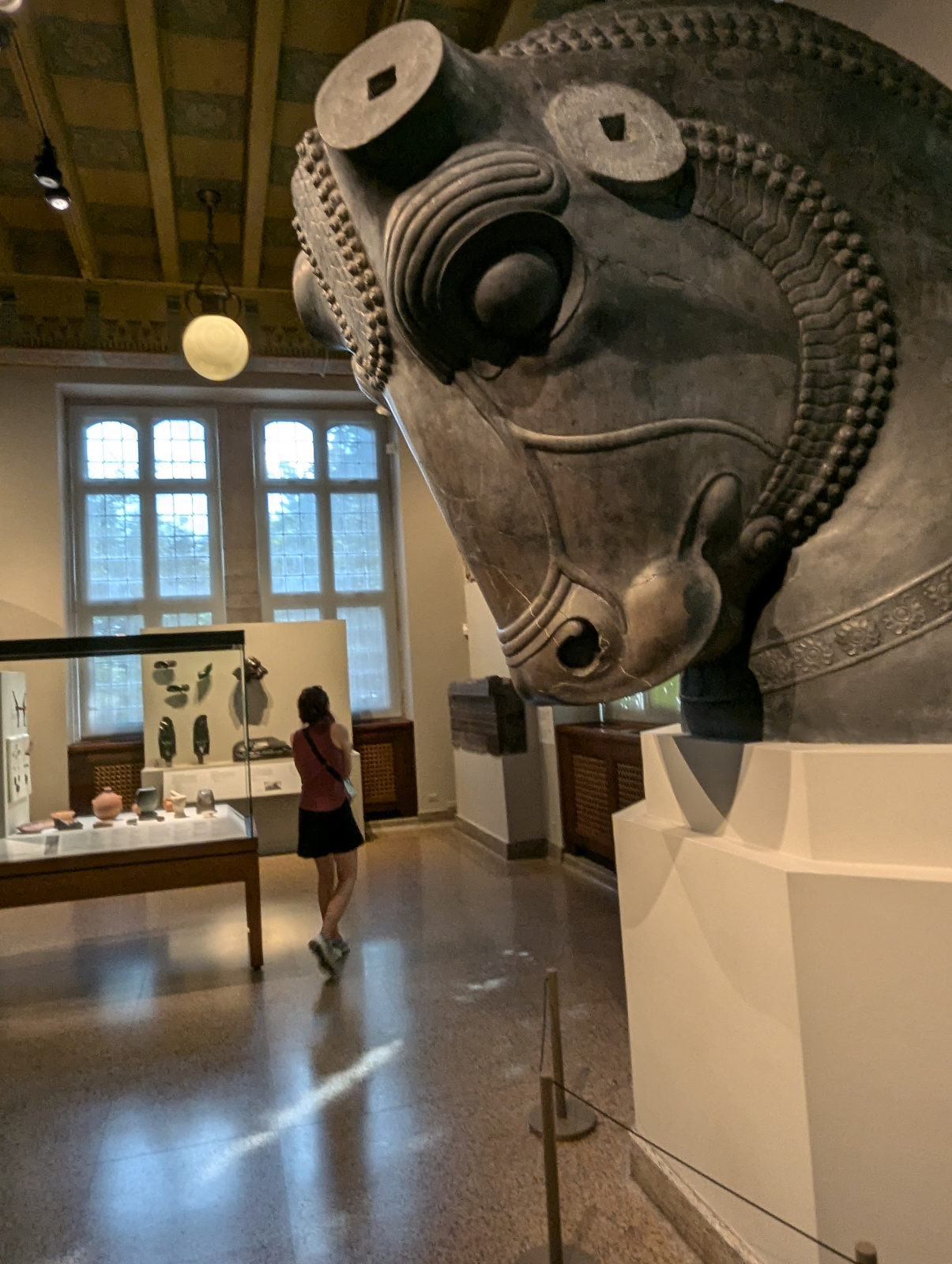
Colossal Bull Head found in Persepolis, Iran – Photo by Joel Grimsley
The Robert F. Picken Family Nubian Gallery includes exhibitions on politics, and contrasting cultures in southern Egypt and Northern Sudan. The Robert and Deborah Aliber Persian Gallery includes artifacts that trace the rise of cultures in ancient Iran, centered around the Colossal Bull Head excavated by ISAC in Persepolis, Iran.

Chicago Field Museum – Photo by Joel Grimsley
Following the self-guided tour of the University of Chicago’s Institute for the Study of Ancient Cultures, AQ History Club participants traveled to the Field Museum for a second self-guided tour of their numerous exhibits. The Field Museum, located on the north side of Chicago, contains a vast number of exhibits on various subjects open to the public (through general admission), and a few that require further ticket purchases or memberships with the museum itself. With a total of 36 general admission exhibits, the Field Museum has much to offer for individuals of any demographic, history enthusiasts included.

SUE, the famous Tyrannosaurus skeleton of the Chicago Field Museum – Photo by Joel Grimsley
The most well-known of the exhibits includes The Griffin Halls of Evolving Planet where the famous skeleton of SUE the T. Rex is displayed. In this exhibit visitors are able to explore the evolution of the planet Earth, walking through the life and death of species, often due to mass-extinction events. Other well-known and popular exhibits include the Grainger Hall of Gems, the Nature Walk & Messages from the Wilderness, and Inside Ancient Egypt.
The Field Museum is also home to exhibits that center around the lives and experiences of Native Americans and Indigenous individuals in the United States, in the Native Truths: Our Voices, Our Stories exhibit, and the Pawnee Earth Lodge, a full-size replica of the classroom, home, and ceremonial place of the Pawnee people of Nebraska. The Field Museum also houses the Regenstein Hall of the Pacific, which focuses on the culture and diversity of the Pacific Islands, as well as the Robert R. McCormick Halls of the Ancient Americas that focuses on the Pre-Columbian cultures and civilizations of the Americas. While the aforementioned exhibits are only a few of the carefully maintained and curated exhibits in the Field Museum, they offer a few highlights to consider when visiting.
The final scheduled stop for the AQ History Club participants resided in the Art Institute of Chicago where students from both the History Club and Art Department gathered to board the bus and return to Michigan. Once boarded, many trip-goers discussed their experiences, what they learned from the institutions they visited, and general highlights of the trip before settling in for the ride back to the AQ Campus. “I really liked when they talked about the replication process and how they made the eyes different so that they could test out different materials,” said senior Lindsey Harvell of the copy of the Bust of Nefertiti.
“I thought it was really fascinating to see all the tools, and the furniture and the things they used,” said sophomore Atlan Lasher of the ISAC exhibits. “I always liked looking at those [exhibits] because it’s so interesting to see how people lived back then… I always think that’s really interesting.”



 The Saint