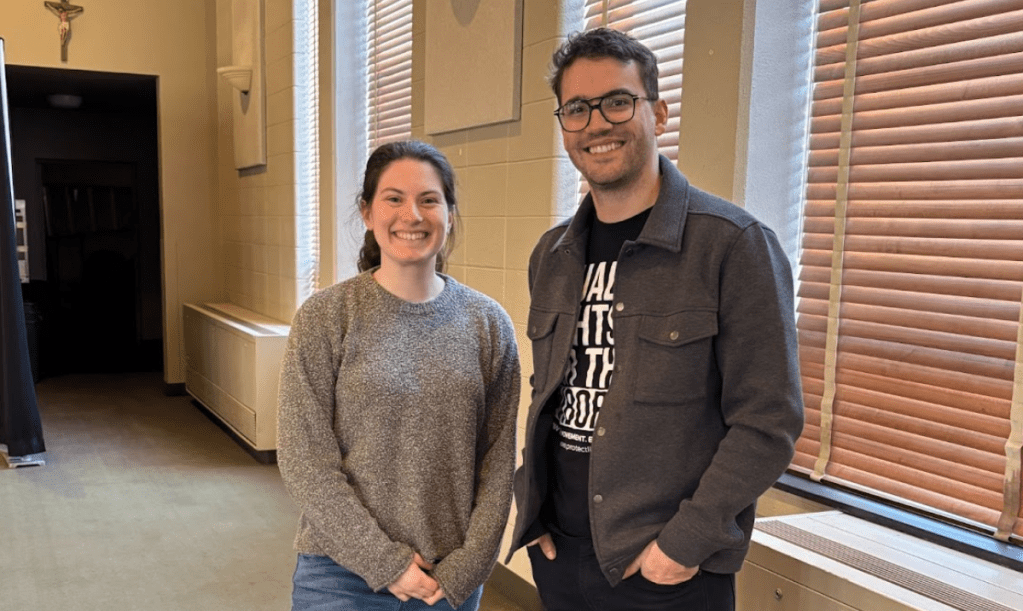
By Zoebelle Bean, Catholic editor

Trevor Polo speaking on the issue of abortion – Photo by Zoebelle Bean
Trevor Polo, executive director for Protect-Life Michigan, delivered a talk on whether abortion was a reproductive right or a human injustice in the Wege Ballroom on April 11. He was invited to Aquinas’ campus by Dr. Jonathan Fritz, an adjunct chemistry professor at Aquinas College, and Anna-Marie Comden, president of the Pro-Life Club.
Polo began by explaining the history of where the pro-life movement came from. “Someone is right and someone is wrong on this issue,” Polo said. “We can’t both be right at the same time. If [pro-life is] correct, we have the mass killing of people, and we have the basic stripping of rights from individuals if we’re wrong.” He started by explaining the 1857 Supreme Court decision on Dred Scott. He sued for his right to freedom from slavery and the Court decided he was not a person under the U.S. constitution. “Biologically, he was human,” Polo said, “but he was denied personhood.” The ruling denied both his freedom as well as a bit of his humanity.
Today, Polo said, the population of humans say the unborn are not persons under the law, just as in the case of this Supreme Court case. “Not because they don’t exist,” Polo said, “but because it’s inconvenient to recognize their value.” This harkens back to other laws that were legal but profoundly unjust. He asked the audience to think back to instances in history where a profound injustice was found, but the law protected it from being fixed. Instances such as child labor in America, the case of Emmett Till and his murder and even today, where women in other countries who have transgressed against their husbands are dragged through the streets and killed for their actions.

President of the Pro-Life club, Anna-Marie Comden and Trevor Polo – Photo by Zoebelle Bean
Polo claimed that it was not a question of what the law says, but what the law ought to say. It was the basic nature of human rights that allowed most of the aforementioned problems to be corrected and realized for their inhumanity. Polo said humans all have a basic belief in equal access to human rights, but he wondered why they do. “What grounds this belief?” Polo said. “It must be something we all possess, at the same time, equally.” He proposed it was a shared concept, and this concept was a shared humanity. No matter what, everyone is human, and people do not need to prove it, they will always have it and they will never lose it.
In order for the unborn to share in this humanity, humans need proof that it is alive, and that is left up to science. “Approximately 96 percent of biologists will affirm the humanity of an unborn child from fertilization on,” Polo said. However, many argue that the difference between humans who are seen and heard and those in the womb are about the “abilities” they have. Things such as the difference in brainwaves and development, the nature of the relationship between the mother and child and the difference in environment between grown humans and the unborn are significant.
Polo proposed that these differences are very real, but just because they are smaller than people does not mean others can treat them with violence. “Just because I’m located here, right now,” Polo said, “and take a few steps to my left, it does not impact my fundamental human rights, giving you the right to treat me with violence.” The issue of differences should not allow others to treat the unborn with violence. They still have fundamental human rights, Polo said.
“As Greg Koukl sums it up,” Polo said, “‘If the unborn are not human, then no justification for abortion is necessary. However, if the unborn are, in fact, human, then no justification for abortion is sufficient.’”
Polo continued on to present some pro-choice arguments and debunk them. He began by explaining Judith Jarvis Thompson’s argument about a violinist being connected to an unsuspecting person in the middle of the night. This argument proposed that if someone were to be connected, vitally, to a violinist in the middle of the night without their approval or awareness, then this person would have a right to disconnect them and essentially kill them without moral judgement. This led to the bodily autonomy argument that a woman has the right to do what she wants with her body, and therefore justify abortion.

Polo presenting the “Violinist Argument” – Photo by Lauren Vanderwulp
Yet, Polo found a key flaw in this argument. He said that this argument confuses what is actually killing the child in abortion. When the victim disconnects from the violinist in Thompson’s argument, it is the violinist’s own organ failure that kills him, which is a natural process of death. Yet, in the abortion procedure it is not a natural death process. It is the forceps or the poison that takes the child prematurely. It is not saying you do not want to keep giving them the essentials they need to survive, it is saying you are losing a life that would have otherwise not have been lost. This argument confuses giving or lending support with abortion, which is the intentional ending of a life.
The argument also assumes the child is an unnatural invader and has a parasitic relationship with the mother. “However, there is really no other use for a womb than to house another human being,” Polo said. “It is actually entirely natural for a child to be where they are at for the first nine months of their existence.”
Polo also presented and debunked the “Burning Lab” argument. This is an argument that says there is a lab containing vials of embryos and a small child, and if the lab were to burn, the person has the choice to save either the child or the embryos, but not both. Most people would save the child. “The arguers would then say,” Polo said, “‘see, you pro-lifers, even you don’t believe than an embryo or a zygote or even a fetus are the same thing as a born child, because when push comes to shove, you would save the little girl, and not the petri dishes.’” Yet, Polo said that this is wrong and the pro-life stance does not fall apart here. Whoever you save, it does not change the fact that the embryos are still living things. The person who makes the decision is not denying the embryos humanity. The argument fails to see that humans are also emotional people. Humans make emotional decisions, and if they saw a crying human, they would be emotionally guided to save them since the embryos cannot evoke the same initial, human emotional response.
Roughly 40 people attended the talk in total. “I liked the format of his talk, and the examples he included,” junior Juliana Decker said. “I had never heard of the violin example before. I personally think that if there is so much grey area of debate in the ethical component of abortion, then maybe we are not in a position to make a one for all decision for everyone else.”
Wege Catering also provided a variety of fruits, drinks, spring rolls and meatballs for the event for attendees to eat. Polo spoke for about an hour on the topic of protecting the unborn, and allowed time at the end for people to ask questions.
Polo offered a final comment at the end of his talk for all those who did not attend. “It’s important for people who know the reality of what abortion is,” Polo said, “to not just stop at knowing but to move on to doing something about it and being a voice to other people.”

Food provided by Wege catering – Photo by Zoebelle Bean
Father Bob Keller, O.P., came to the microphone to offer an insight into the issue of pro-life. “In our society, we are total materialists,” Father Bob said. “If we can’t see it, it doesn’t exist. If we can’t measure it, it doesn’t exist… and this is a problem with the fetus problem.”
Polo responded by adding that humans need to be advocates. Other people with their own issues can go to the polls or garner support through democracy, but pro-lifers have to advocate for someone else who does not have a voice. This is the inverse of any normal cause, where a group initially advocates for themselves and then gets outsiders to join their cause. The unborn cannot advocate for themselves. “Cultures are designed to preserve and they don’t like change,” Polo said. “It takes agitation.”
Another woman from the audience offered sympathy for the pro-life movement and those affected by abortion. “I come from a time period when abortion just became legalized,” she said. “I think the emotional aftermath for women who have abortions is missed in our arguments and stances. I haven’t met any women who have been completely satisfied in the aftermath. I’m also sorry for the men who are husbands who are damaged and hurt by this.”

 The Saint