
By Gionna Bean, Opinion Editor
The Aquinas Writing Center (AQWC) is currently celebrating its 15th anniversary. Over the past 15 years, the center has grown significantly– adding more consultants and changing locations. Yet one thing has remained constant: its mission to develop the writer, not just the writing.
One way to encourage writers to attend consultations is to make them required. This approach is commonly used in first-year seminars and block classes, where students are often asked to attend at least one WC consultation for course credit.

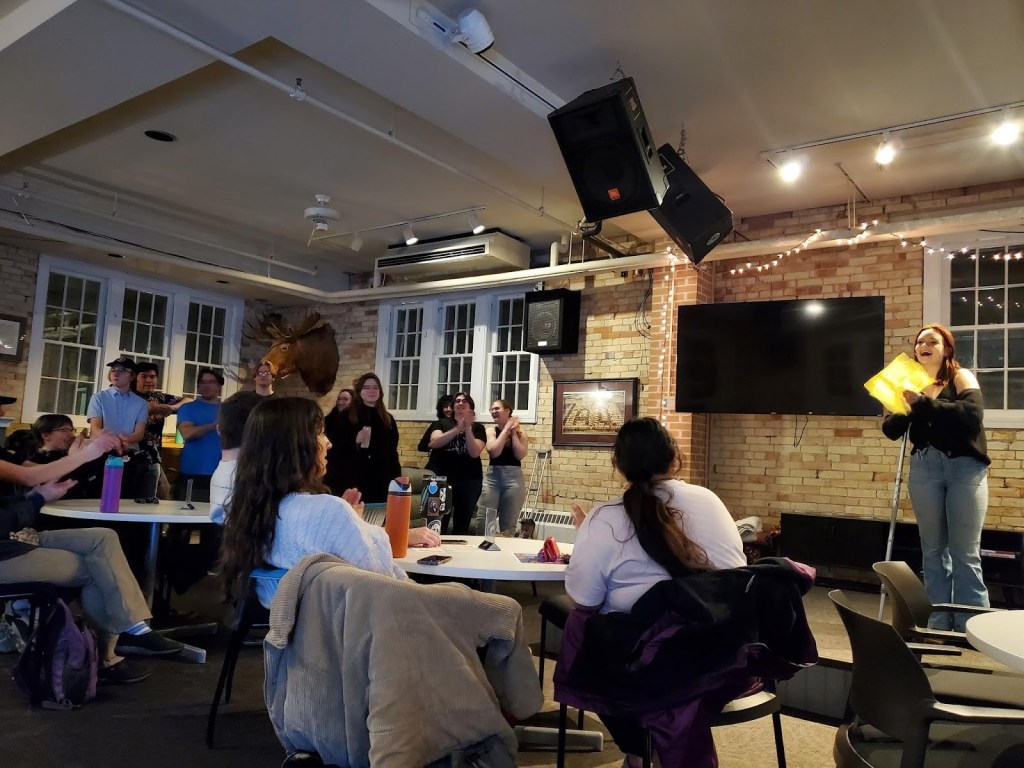
AQWC workers converse – Photo by aquinas.edu
Making any activity a requirement comes with some qualms, particularly for first-year students unfamiliar with academic support resources. However, it can also serve as an important introduction to the WC’s purpose.
Misconceptions about the AQWC, such as the belief that it is only for struggling writers, may lead to hesitation or skepticism among new students.
Julie Bevins, Coordinator of the AQWC, notes that required visits can help challenge these assumptions. “There can be mistaken notions about our writing and consulting,” Bevins said. “At first, some students think: ‘I’m a good writer and the WC is only for bad writers’. Some think: ‘At the WC, they’re going to rip up my writing and shame me.’ Some think: ‘I do not have time for this and I can do it better on my own.’ The only way for some students to discover the value of a consultation with the WC is to be required to visit.”
Freshman Ondreana Mathers is a first-year student who was required to attend a WC consultation for her first-year seminar with Dr. Keway to go over her first paper in the class. “Since it was my first time I was a little nervous to go, not knowing what to expect, but they were super chill and welcoming and were able to walk me through the process, helping me with any questions I had,” Mathers said. She also encourages other students to go, even if they initially feel uncomfortable. “It is really helpful and doesn’t have to be something you are scared to do,” Mathers said. “It is a resource you get for free on campus so use it.”
Required consultations are not only an uncomfortable experience for students, but for consultants as well– a necessary uncomfortability. “It’s always good to have someone peer review because you might find out that your paper does not make as much sense to other people as it does in your head,” junior Maria Hillary, Writing Consultant, said. “However, because it’s required, some people are not as engaged to work with us, and that can make it difficult to try and help them if they’re not at least willing to hear our suggestions.”
The first consultation may be a challenge, but Dr. Gretchen Rumohr, Director of the AQWC, explains that it is required consultations and the feedback that comes with them that keep students coming back. “Research shows that the more empirical required Writing Center visits at the very least do no harm, and at the very best, improve students’ self-efficacy and skills,” Rumohr said. “Empirical research shows that required Writing Center visits at the very least do no harm, and at the very best, improve students’ self-efficacy and skills,” Rumohr said. “In fact, research done by Beth Jensen, Julie Bevins and I showed that required visits, and specifically the feedback forms that come at the end of those, made students more likely to have a positive experience. Filling out the feedback form allowed students to reflect on their visit, and usually they saw that more good than bad came out of it.”
The feedback form is emailed to the student after the consultation and only contains two parts: “How did your consulting experience contribute to your writing process?” and “Please make any additional comments you wish below.” The AQWC reads over feedback and uses it to brainstorm improvements at weekly meetings. The AQWC is meant to cater to the student body, which means it’s ever changing and adaptable to the needs of all students.
While required visits may be inconvenient at times, they are truly what encourage new students to attend consultations by their own decision, which is the goal of the Writing Center.


 The Saint