
By: Anastasia Benstead, Assistant Editor-in-Chief

Capitol building in Lansing – Photo by Michigan State Capitol
Michigan Governor, Gretchen Whitmer, denies that there was a state government shutdown this week. With a split House and Senate, legislators were unable to agree upon a satisfactory budget at the start of the fiscal year early on the morning of Oct. 1.
The state Senate passed a continuing resolution at 1:30 a.m. in a 31-2 vote, allowing the state a week to continue working on drafting a budget, with a new deadline of Oct. 8. In a vote of 103-4, the House signed off on the proposed extension 20 minutes later. House Bill 4161 then went to Witmer’s office for a signature slightly before 3:30 a.m. Records show Whitmer signed the bill at 4 a.m.
The constitutional deadline for passing a state budget was Oct. 1, the start of the fiscal year. Technically speaking, Michigan has a proposed deadline of July 1 to pass a tentative budget, however with no negative consequences for not reaching this goal, legislators rarely succeed in outlining a budget before the fall.
Since a continuing resolution was passed four hours after the deadline and well before the start of the workday, the state government was never technically shut down. Whitmer sent communications to all state employees the night of Sept. 30 encouraging everyone not to worry as they would go into work the next morning.
“There is a lag of more than a week between the hours state employees can work and when they actually get paid,” Rep. Bryan Posthumus, R-Rockford, the House Majority Floor Leader said. Essentially, this means that having state employees work without an approved budget or resolution, which was the case as of Sept. 30, there would have been more significant repercussions of shutting down all state authorities than allowing employees to work without technically having the funds to pay them.
The continuing resolution allocated $1.56 billion in temporary spending until an official budget could be passed– roughly covering the cost of state operations for a week until the new deadline of Oct. 8. Without a budget, schools like Bloomfield Hills emailed parents that alternative district funds would not be used to cover the cost of free breakfast and lunch for k-12 students. Whitmer responded with a letter on Oct. 2, co-signed by the State Superintendent, Michael F. Rice, urging schools to do “what it takes to feed every kid as we wait for the budget.”

Copy of letter sent out to all schools by Whitmer and Rice – Photo by the office of Gretchen Whitmer
Districts like Northville Public Schools released a statement on Oct. 2, independent of the letter from the Governor, to all parents addressing the issue.
“[We] will pay for school meals for all students for a month even if there is no state budget,” RJ Webber, superintendent of NPS. The estimated cost for the district would have been $400,000.
A state budget was passed at 1:47 a.m. on Friday morning, Oct. 3. The total for the budget was $81 billion dollars, only slightly less than the Democrat’s proposed budget of $84 billion, but still higher than the House Republican’s proposed $78.5 million which wanted to see a significant reduction in medicaid provisions from tax revenue. The state budget passed last year was $82.5 million.

State legislators around 1 a.m. attempting to pass a budget after the start of the fiscal year – Photo by Michigan Senate Democrats
Notably, the approved budget includes a 24 percent tax on marijuana sales in a campaign informally called “pot for potholes” in which the generated revenue will be used to improve Michigan roads and infrastructure. This controversial issue has led to dozens of people protesting on the capitol lawn in Lansing this week.
“Since recreational cannabis was legalized in 2020, [marijuana has] raised nearly $2 billion in taxes for Michigan over the last five years,” said Mike Mike DiLaura, CCO and general counsel for House of Dank. He and many others feel that this stipulation in the government will directly harm Michigan dispensaries and employees.

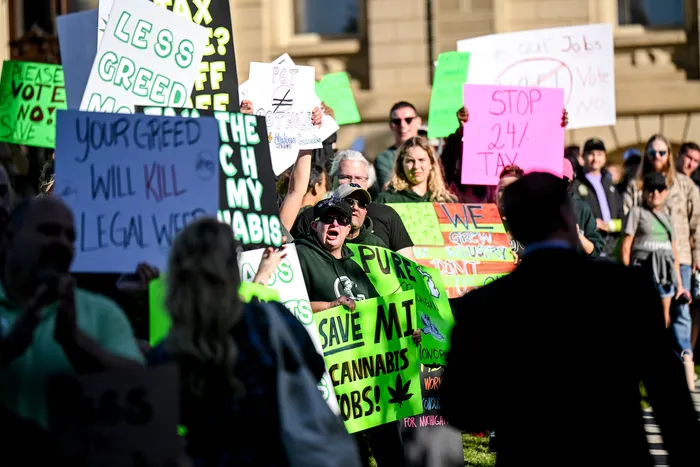

Protestors outside the capitol building in Lansing – Photo by the Lansing State Journal
The marijuana industry is relatively untapped as previously the only revenue source for the state government was from the six percent sales tax. The additional cost for dispensaries and customers directly helped school districts from receiving budget cuts this year. The act also received bipartisan support and passed in the House with a vote of 78-21 vote. The Senate approved the act minutes later.
The last time Michigan legislators failed to pass a state budget was Oct. 1, 2009. Former Governor Granholm released a statement on Sept. 28 telling residents that they were making preparations for a shutdown. Similar to what occurred this year, the shut down only lasted for about 3 hours. The shut down before that was in 2007.
The federal government has also not passed a budget for 2026. This will be the first time in 5 years, with the most recent shut down being in 2018-19 after Trump’s first election when government functions were suspended for 35 days over U.S. and Mexican border disputes.

Government shut downs by year and presidency – Photo by NPR
Fortunately the state budget has been passed with very few lasting repercussions. The U.S. Senate adjourned at 3:57 p.m. and is not scheduled to reopen its session until Monday Oct. 6, the sixth day of the shutdown. The House delayed its session and has no plans to meet in this upcoming week. The House has also rejected a continuing resolution, which would break the shut down, four separate times.




 The Saint