
By John Petty, Catholic Editor

“The Door to Mercy” – Photo by John Petty
Every Liturgical Year in the Roman Catholic Church concludes with the Solemnity of Our Lord Jesus Christ King of the Universe, and begins with the season of Advent. This season has a preparatory purpose focused on the second coming of Christ, as well as his first coming in the incarnation.

Icon of the King of the Universe – Photo by John Petty
“I think Advent is a really wonderful season in Catholicism, because people are so joyful,” said junior Nolan Ostrowski.
While the coming Season of Advent is certainly oriented towards the Incarnation of Christ at Christmas, the first two weeks of Advent are focused on the apocalyptic reality of the Porousia, commonly known as the Second Coming. It is the third week of Advent, Gaudete Sunday, where the focus is shifted to the birth of Christ.

Michaelangelo’s The Last Judgment – Photo by John Petty
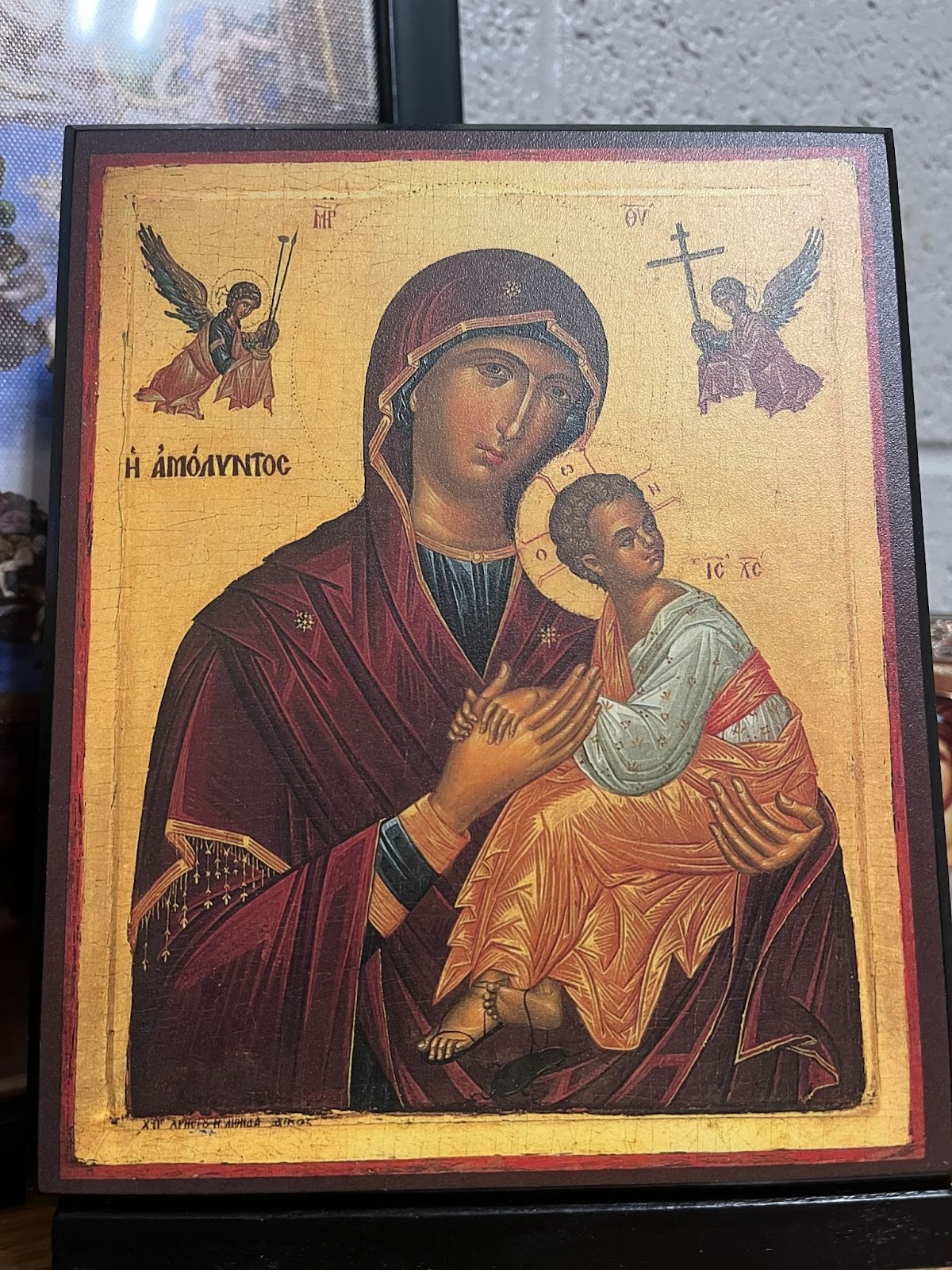
Icon of the Theotokos – Photo by John Petty
“I’m excited,” said sophomore Zachary Miller, an Order of Christian Initiation for Adults candidate. “I’m excited to actually learn what Advent is as a Catholic… participating with all the Catholic practices is exciting”.
“I personally feel like Advent has been used as more of a time of celebration instead of what it’s meant to be,” junior Mary Kampe said. “[It] is a deep preparation of your soul, and heart, and home for the Coming of Christ, which would include fasting, and penance and reconciliation in preparing your heart and soul for our Savior.”
The season of Advent is a time of increased awareness of the immanent reality of Christ’s coming, both in his incarnation and his porousia. As such, Advent is a time for Christians all over the world to examine consciences and draw towards the sacramental life of the Church, particularly in the Eucharistic celebration of the Liturgy, and also in the penitential celebration of Reconciliation. In the Roman Catholic Church, one must be free from all grave sins in order to be eligible to receive the Eucharist at Mass. Therefore, Catholic Churches during the time of Advent often offer penance services to make the mercy of Christ increasingly accessible during this time of preparation.
To make a good confession, all grave sins must be confessed in kind, number and any circumstance that alters or adds to the kind of sin committed. Grave sins involve grave matter, sufficient reflection and deliberate consent. All three of these conditions must be present for there to be a grave sin. Along with confession, there must be a firm resolve not to sin again, with the intention of doing the assigned penance. This teaching is characteristic of the Scriptures, the Council of Trent, the Baltimore Catechism, as well as the Catechism of the Catholic Church. Priests are bound by automatic excommunication if they ever reveal anything disclosed in the context of the sacrament.

Examination of Conscience – Photo by John Petty
Along with doing penance assigned in the sacrament of Reconciliation, there are other penitential practices Catholics may participate in One such practice is fasting, that is, eating lesser quantities of food. Along with this is the established Catholic tradition of abstaining from meat on Fridays, as it has been traditionally practiced along with other penitential practices every Friday throughout the year. One may also fast from technology, and other causes of intemperate habits. The goal of fasting in the Christian life is to conform one closer to Christ, who himself emphasized fasting as a spiritual discipline. Following such penitential practices orients one’s mind toward the season of preparation, and consequently, the coming of Christ into the world.
Following the first two weeks of Advent focused on apocalyptic connotations, Gaudete Sunday begins the focus on the imminent celebration of Christ’s Incarnation in the Feast of the Nativity.
Following the Feast of the Nativity is the Feast of St. Stephen, the first Catholic martyr. Furthermore, the Feast of the Holy Innocents and St. Thomas Beckett, also Martyrs, follow the Nativity. The reason for the placement of these Feasts of Martyrdom after the Feast of the Nativity is to remind the faithful of one of the purposes of Christ’s Incarnation: his sacrifice.
The current liturgical year is coming to an end quickly. With this in mind, prayer, penance and fasting are some ways for Catholics to prepare for this upcoming season of preparation.




 The Saint