By Anastasia Benstead, Assistant Editor-in-Chief
On Tuesday Dec. 2 advocates and members of the Michigan Parent Advocate and Attorneys Coalition, known as MiPAAC, gathered in Lansing at the capitol to meet with law makers and encourage support for the MI Blueprint which would ensure more equitable funding for districts in Michigan serving students with disabilities.

MiPAAC sends representatives to Lansing – Photo by MiPAAC
The day started off with a storyteller briefing in which four women shared their experiences as parents of students with disabilities. The four women came from all over southern Michigan to give their experiences, one of which being Aquinas’ own Amy Barto. The current system of special education is one that favors parents with additional resources, those willing to fight unending battles, and attending higher quality districts.
Heather Eckner, Director of Statewide Education for the Autism Alliance of Michigan, began the event with an introduction before giving the podium to Elise Swinson from Waterford, Mich.
Swinson grew up with undiagnosed dyslexia and was constantly berated by teachers to try harder. She never went to college and feels failed by the public education system that pushed her through until graduation without providing any of the supports she needed.
“I vowed that my children would never struggle the way I did in school,” Swinson said.
Swinson’s daughter was diagnosed at the age of four with dyslexia. Even with an early diagnosis, she did not fare much better than her mother in the public education system.
“The problem is not a lack of effort from teachers, parents, or students,” Swinson said. “The system was never built to best serve those with disabilities.”
Swinson said that she was fed up with the trial and pilot programs that could only be offered to a select number of parents or students with more resources, or lived in the right city. She said that there needed to be one stable system that was equitable across districts– and hence her support for the MI Blueprint.
“The MI Blueprint is more fair, more in alignment of students’ needs, and easier for parents to navigate,” Eckner said.
Next to share was Christiana Bushell from Cass County, Mich. “My daughter is 11 and has limited intelligible verbalized speech,” Bushell said. “She relies on an Augmentative and Alternative Communication Device.”
Her frustrations came from moving from another state and having her daughter spend only two days in the classroom before an individual at the school said that her daughter would be placed in an individualized learning environment without exploring any other options to support her in the generalized education system.
”There was no proposed IEP meeting and no prior written notice,” Bushell said. “I was told by the school that the speech program my daughter utilizes is costly, and not used by other children within the district. They assumed that because she cannot speak, that she cannot learn.”
She wanted her daughter to remain in the least restrictive environment, or the LRE as defined by the Individuals with Disabilities Education Act (IDEA). Within her district there is no assistive technology director within the district. Her argument is that special education is not a space, but rather a network of several supplemental supports. She argued that the one size fits all method of special education did not realize the needs of her daughter and supports the proposed budget structure of MI Blueprint.
Kelly Pepper from Grand Rapids, Mich shared next. Her daughter is in the 3rd grade and has selective mutism. Her educators care for her, but the funding within the school does not align with the needs for the staff. She also argues for more training for social workers and educators.
“Michigan currently reimburses districts for only 28.6% of Special Education costs,” Pepper said. “That is one of the lowest in the country.”
Amy Barto, President of the Learning Disabilities Association of Michigan, and professor at Aquinas was the last parent to share her story. She is the mother of a student with a disability and has been within and around the public school education system for years. Her experiences match those of many other frustrated parents, even with her added level of expertise in the field. It is for this reason that her classes in the School of Education focus on inclusion and fair instruction of all students.
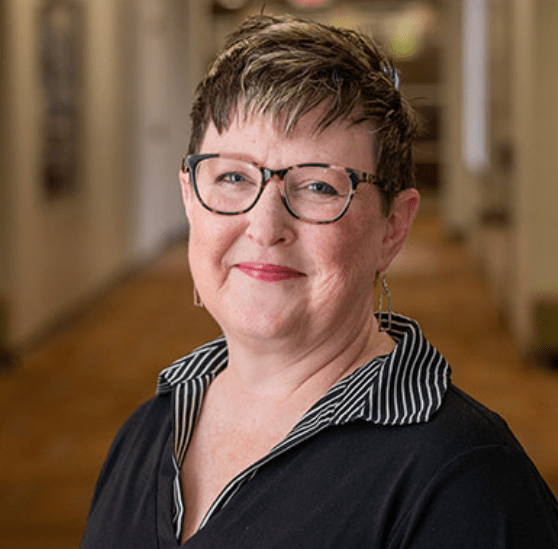
Even as an expert in the field, Amy Barto is not protected from the frustrations of being a parent of a student with a disability and having to fight the public school system – Photo by Aquinas College
“I teach the difference between equal and equitable,” Barto said. “It is a bit like a depressing groundhog’s day carousel ride,” she continued after explaining how her students often wonder why schools would not support a resource that would benefit a student. The excuse is often either a lack of personal, or sufficient funds. This however, is notably against the protections of a Free and Appropriate Public Education guaranteed to all students with disabilities in the IDEA act.
“The experiences of families of students with disabilities so clearly point to a need for change,” Eckner said. “The MI Blueprint is more fair, more in alignment of students’ needs, and easier for parents to navigate.”


 The Saint