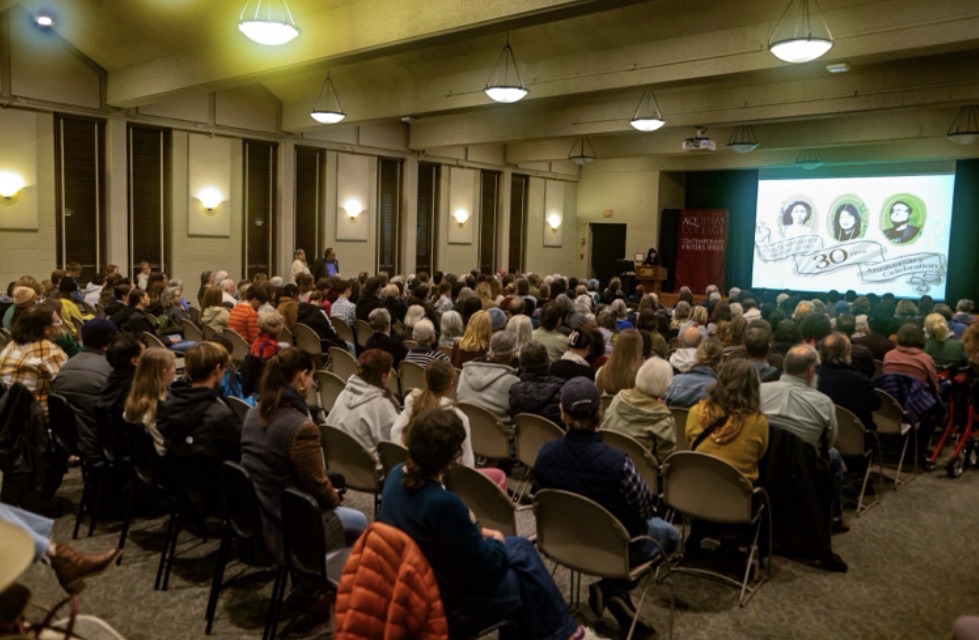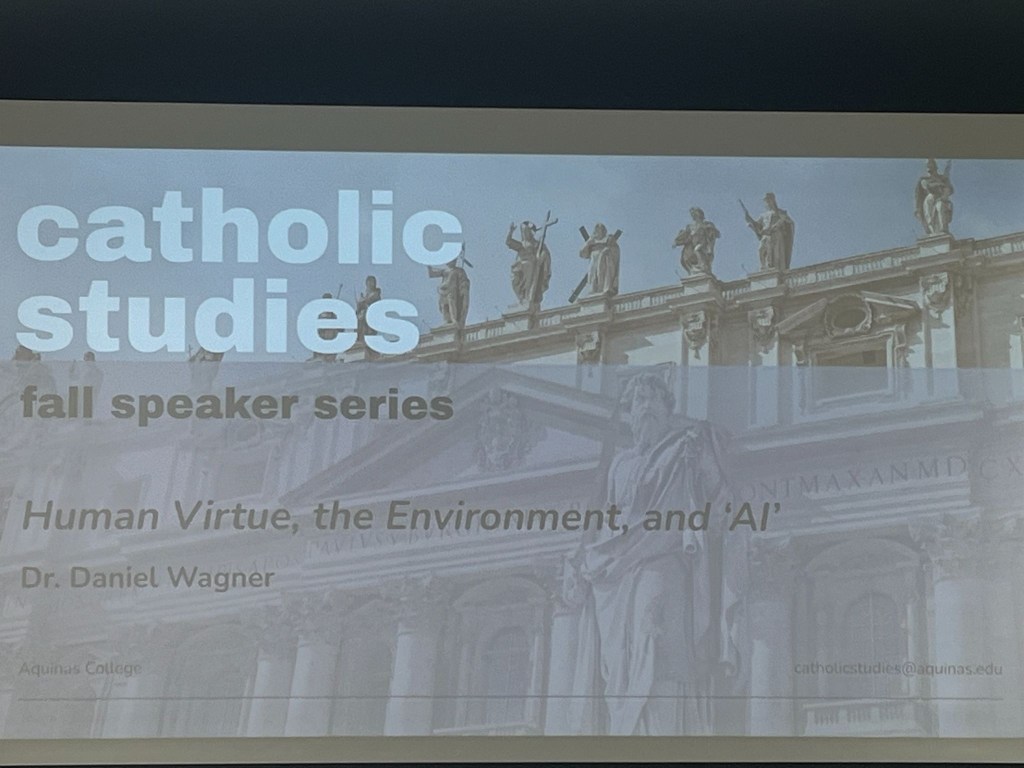
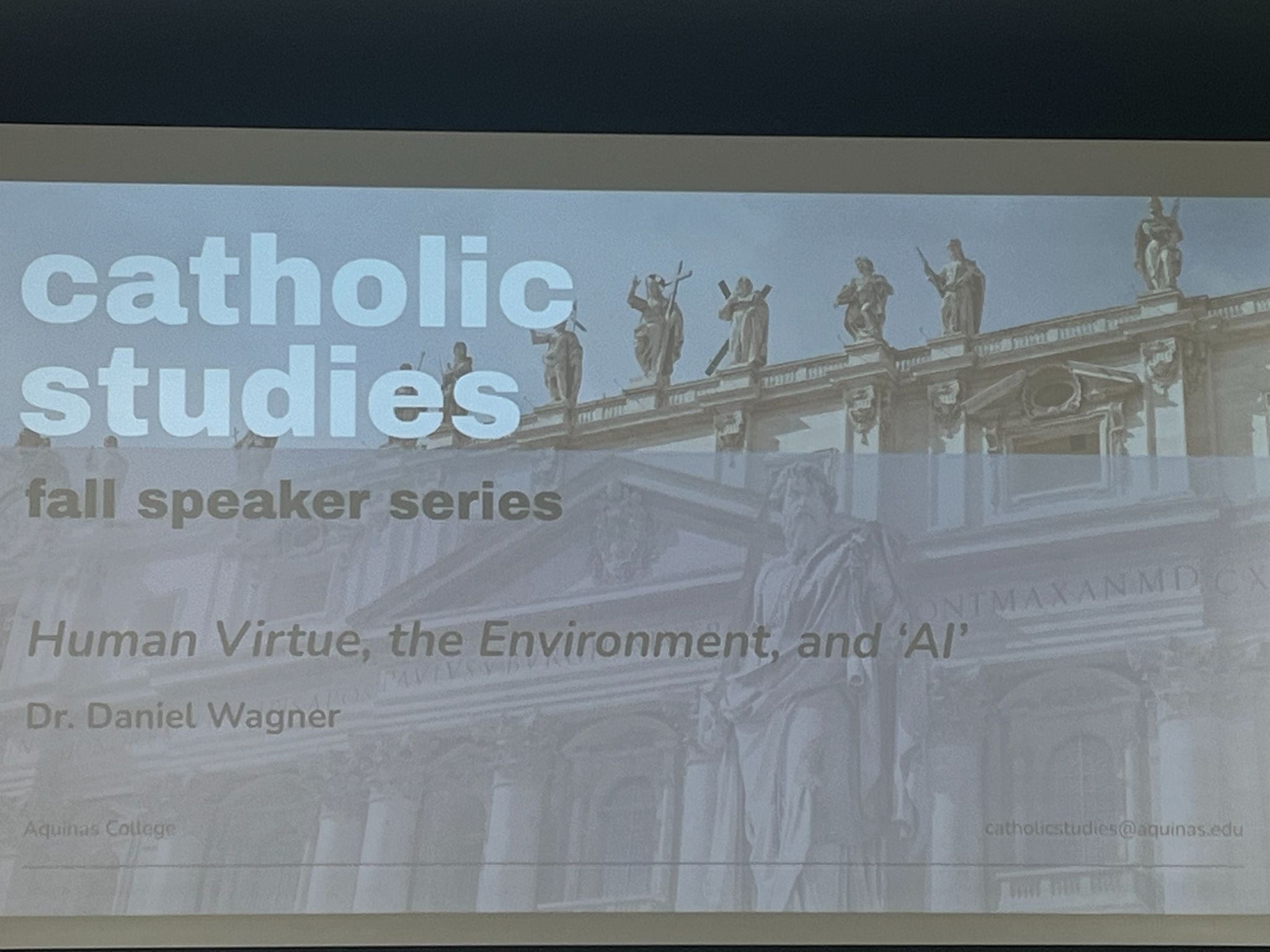
Title screen – Photo by John Petty
By John Petty, Catholic Editor
On Nov. 5, 2026, the Aquinas College Department of Catholic Studies continued the Fall Speaker Series with Dr. Daniel Wagner’s presentation on Human Virtue, the Environment and AI.
Artificial intelligence continues to be a confrontational subject, in academics and beyond. Addressing it from an Aristotelian-Thomistic perspective, Associate Professor of Philosophy and the Chair of Catholic Studies Dr. Daniel Wagner spoke about the human good and its relationship with AI.
Reasoning from the metaphysics of Aristotle and St. Thomas Aquinas, Wagner argued that while AI is not inherently bad, it can inhibit the human good
“How do we use and limit such technology so it is conducive to flourishing and the human good?” Wagner asked rhetorically.
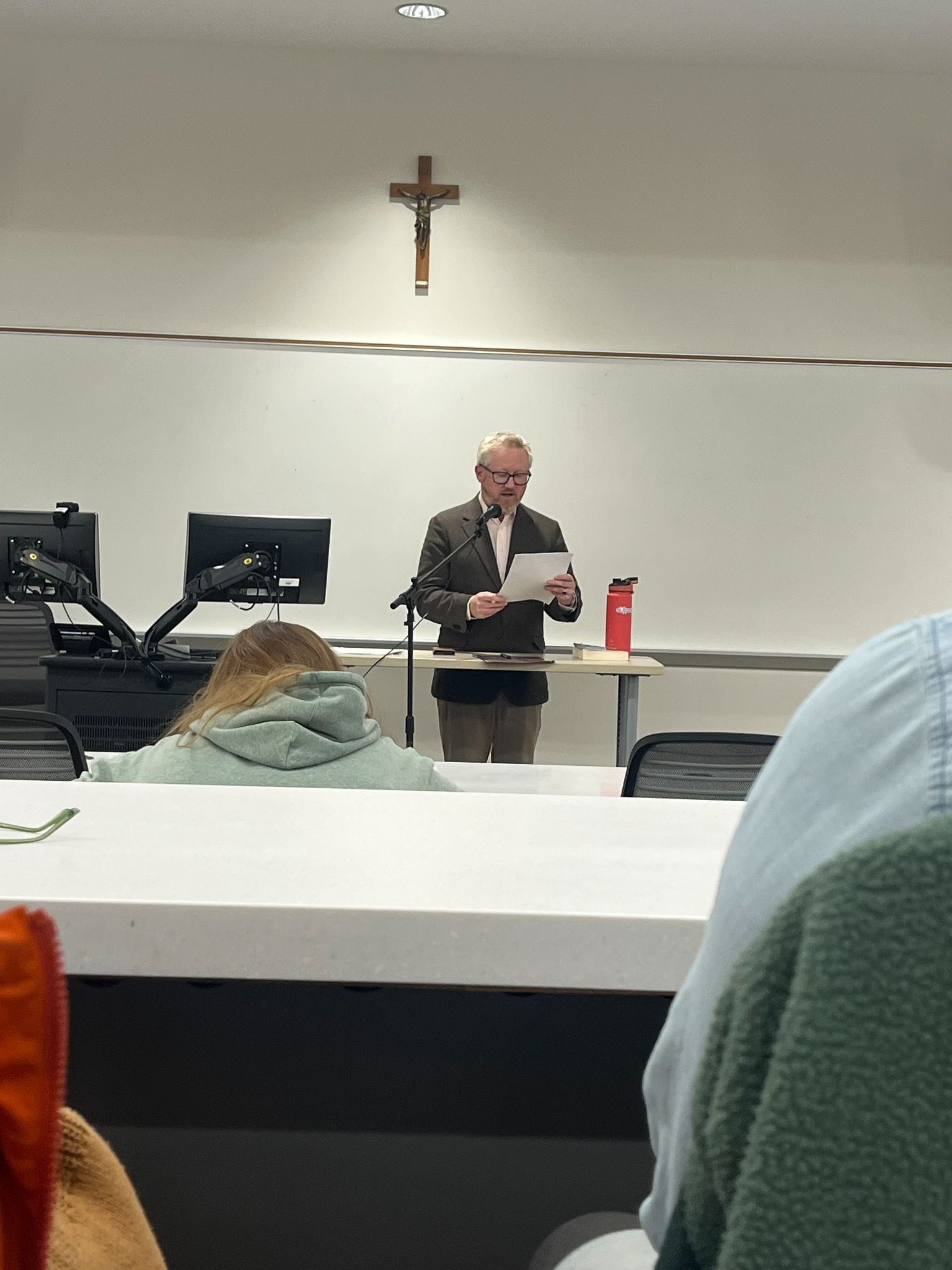
Dr. Wagner presenting – Photo by John Petty
Wagner spoke about the Aristotelian functional account of the human good, also known as the ergon. According to Aristotle, a thing may be spoken of as good or bad in relation to its actualization of its end as a hylomorphic being, composed of matter and form. Wagner spoke about how the eye, for example, is meant to see. An eye may be spoken of as good insofar as it completes its end of seeing, and may be spoken of as bad insofar as it fails in that respect.
Speaking of human beings, Wagner noted that the human being transcends nature via the intellect, and that human beings are ends in and to themselves.
Further, Wagner spoke regarding the ergon following the form, that is, the soul. Wagner spoke of man’s teleological orientation as aimed at living the moral and intellectual virtues. Regarding the moral virtues, Wagner listed Temperance, Fortitude, Prudence and Justice.
In addition to these virtues, Aristotle also speaks of other conditions that are conducive to a good life for a human being, such as: friendship, a certain amount of wealth, citizenship and rights, as well as health.
Regarding artificial intelligence, Wagner spoke of three points in particular.
Firstly, human technology should be used in a way that aids the human good and virtue, and is not antithetical to it. Second, there exists an obligation to only objectify nature when it is necessary for human flourishing. Third, nature has extrinsic value. Human beings have an obligation to steward it and use it in a prudential manner, so human beings can flourish now and in the future.
Wagner spoke of the dangers of relying on artificial intelligence for students, arguing that overreliance on it can inhibit the human good regarding intellectual and moral virtue. For example, if a student fails to develop the skills necessary to think and argue for themselves, they will not be happy, for they are depriving themselves of the completeness of their rational and moral abilities.
“It [AI] is like a calculator, it can be used for good,” said Wagner.