By Nevaeh Porter, Arts Editor
On Nov. 15, the Aquinas Music Department held their Fall Choir Concert.
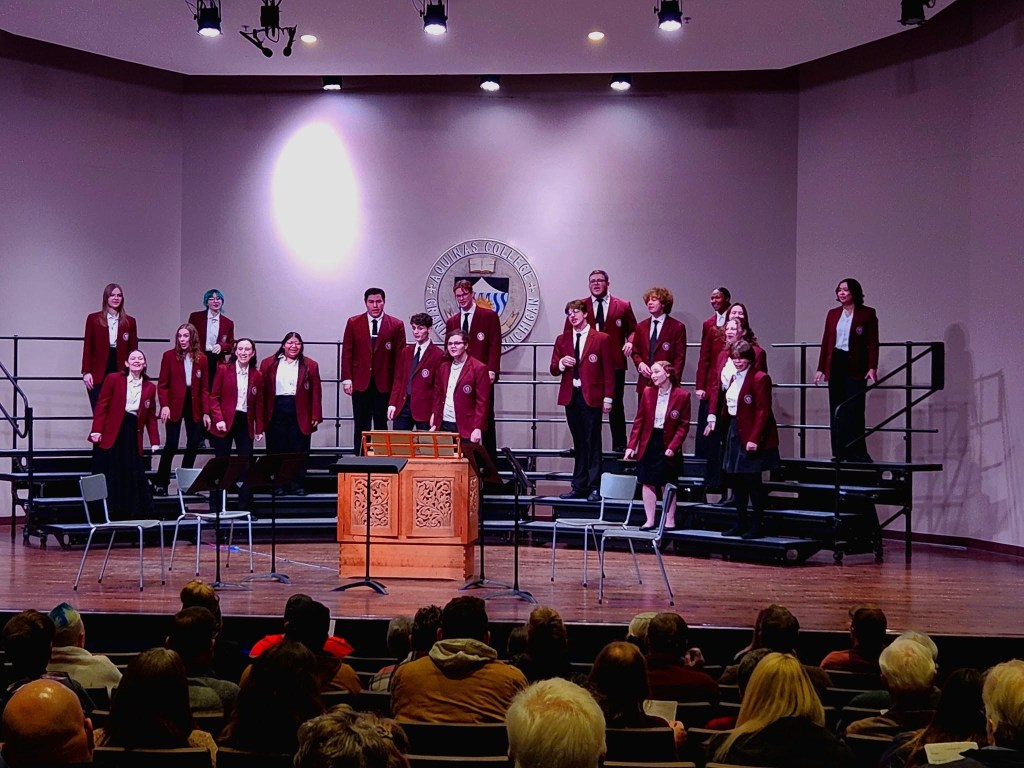
The performing choirs included the College Chorus, Chamber Singer, Aquinas Vocal Ensemble and Three and a Half Men.
The concert opened with the College Chorus. They were first led by student conductor Clara Suerdieck through Francis Scott Key’s composition of the “Star Spangled Banner” that was arranged by James McKelvey. They were then led by Choral Director Doctor Mark Webb through the “Aquinas Alma Mater.” The music for the Alma Mater was composed by Jack Fortner, while the lyrics were written by Dr. Webb.
They then sang “Consecrate the Place and Day” by Lloyd Pfautsch and “Sing Me to Heaven” by Jane Griner and Daniel E. Gawthrop. “Consecrate the Place and Day” by Lloyd Pfautsch is a standard 1969 edition that appears on many state lists and is a frequent choice for choirs who go to Choral Festival. This song was conducted by student conductor Henry Vredevelt.
“I thought they did a lovely job,” Vredevelt said. “It was clearly one of my favorites because I chose to conduct it and I like how it brought the energy out of the choir.”
“Sing Me to Heaven” by Jane Griner and Daniel E. Gawthrop is a sensitive work that expands, but doesn’t expand beyond the bounds of its four-part harmony framework. Student conductor Amelia Huysentryut conducted this piece.
“The choir emotionally locked in more than they had in rehearsal and it was a very positive and moving experience,” Huysentruyt said.
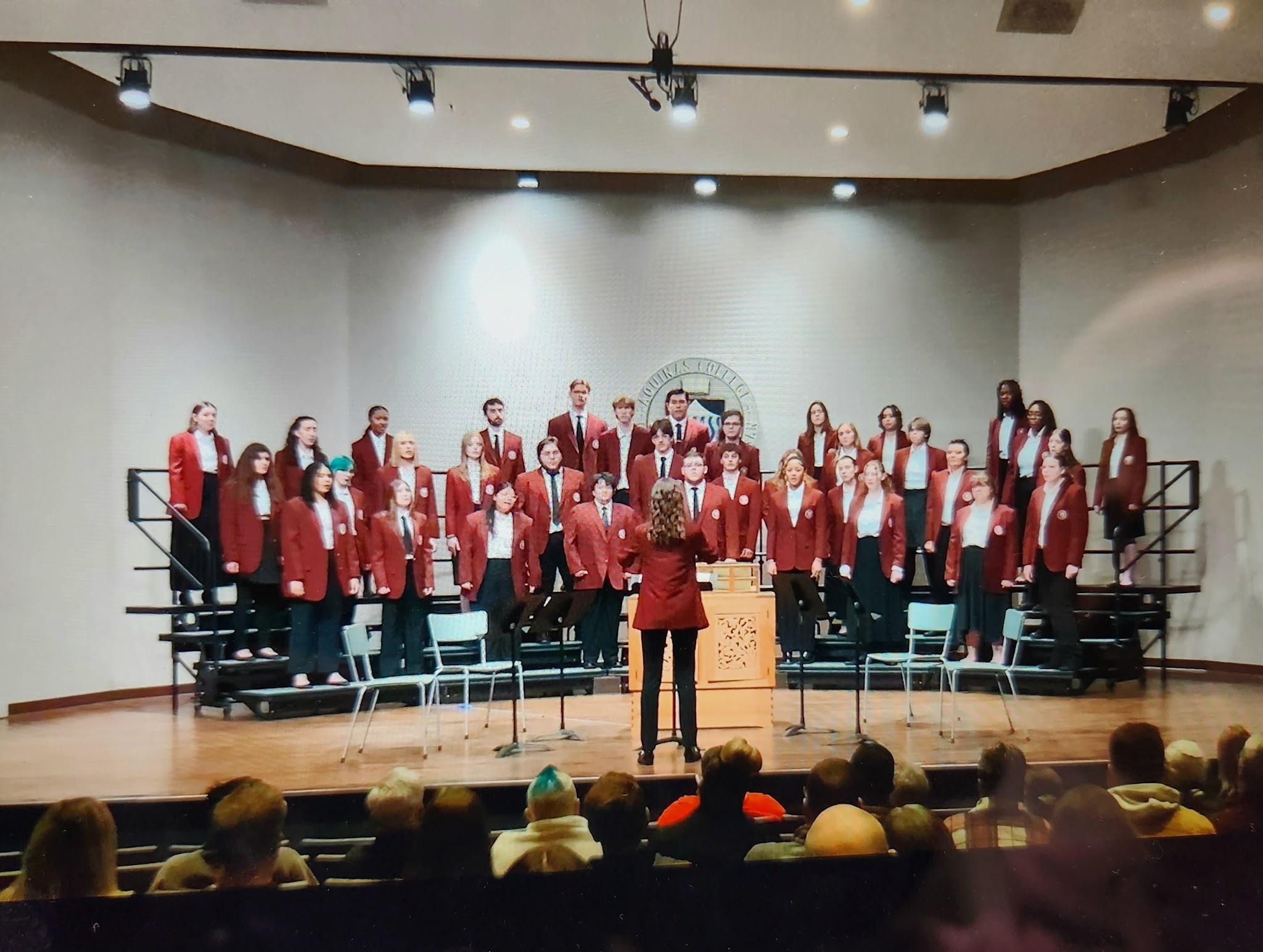
Huysentruyt conducting the College Chorus – Photo by Olivia Easler
The Aquinas Chamber Singers are a group that has evolved and grown here. They went on a tour at different churches and parishes last semester and have only grown from there. This semester they performed Josef Rheinberger’s “Three Advent Motets: III. Ad Te Levavi, IV. Ex Sion and VII. Benedixisti” and Josquin de Près’ “El Grillo.” “El Grillo” is a lively Renaissance early secular Italian song with four voices. The homophony, crisp rhythmic lines mimic the chirping and mannerisms of the cricket.
“III. Ad Te Levavi” means “To you I lift up my soul” and is a part of Rheinberger’s “Neun Adventsmotetten (Nine Advent Motets).” This specific motet is characterized by a mood of quiet trust and spiritual longing. It relies on the rich chordal declamation that is emphasized by brief and flowing imitated passages. Verses for this motet are taken from Psalms 25.
“IV. Ex Sion” means “Out of Zion” and is a part of Rheinberger’s “Neun Adventsmotetten (Nine Advent Motets).” Text from this motet is taken from Psalms 50 and shifts the piece to a brighter and more declamatory character. Rheinberger conveys the resonance and majesty of God shining forth from Zion through crisp rhythmic motifs and resonant homophonic textures.
“VII. Benedixisti” means “You have blessed, O Lord” and is a part of Rheinberger’s “Neun Adventsmotetten (Nine Advent Motets).” Based on Psalms 85, the lyrical, arching melodical lines and lush harmonies that convey gratitude and hope for renewal, all capture the joyful anticipation of Gaudete Sunday.
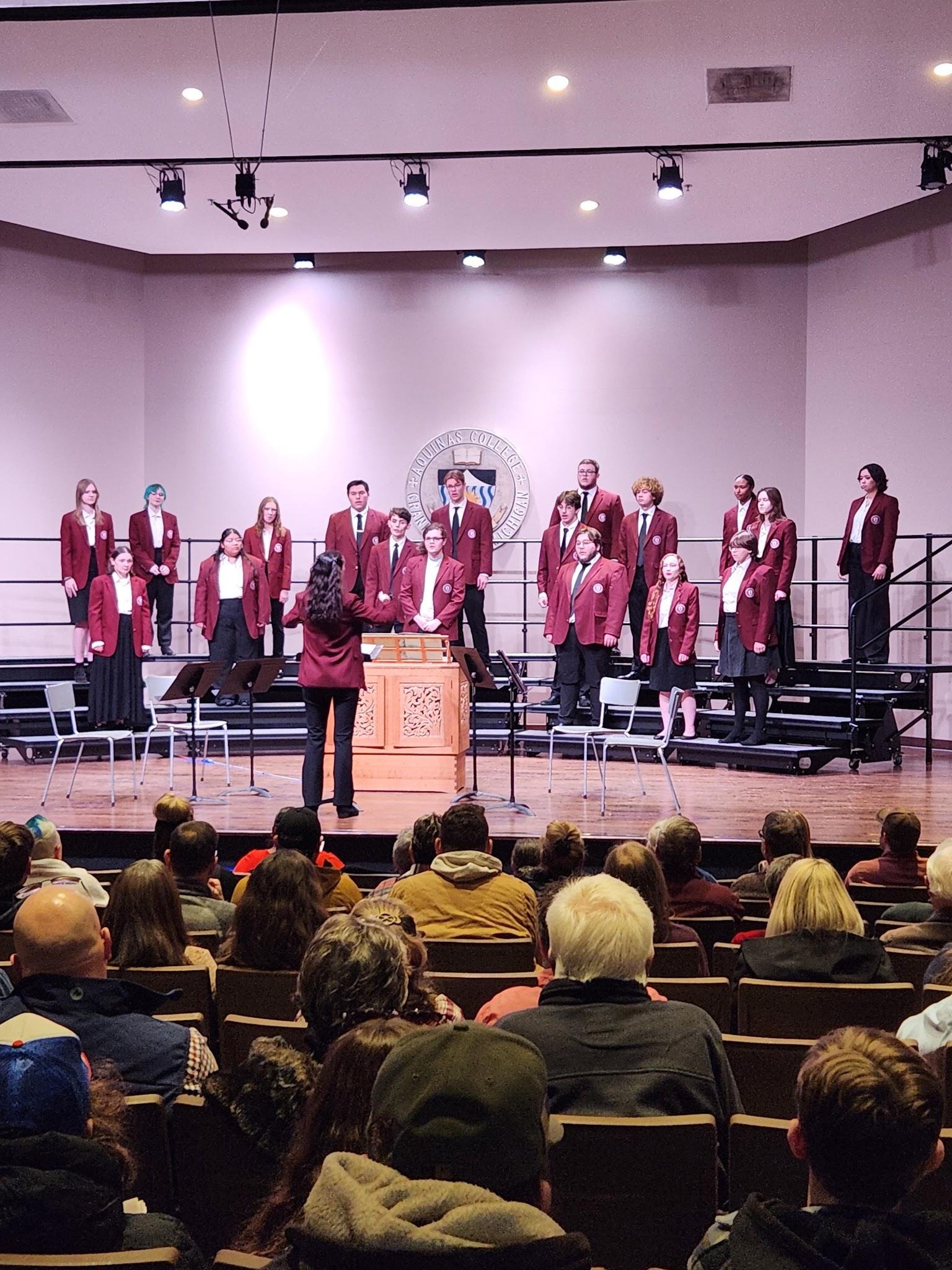
O’Neill conducting “Ad Te Lavavi” with the Chamber Singers – Photo by Nevaeh Porter
Three and a Half Men are a group consisting of four members of the choirs, Xavier Memije, Huysentruyt, Spiteri and Vredevelt. They performed two pieces: “Moonglow” by Wil Hudson, Eddie DeLange and Irving Mills and arranged by Don Webster and “Coney Island Baby” by Les Applegate, Joe Goodwin and George W. Meyer, and arranged by SPEBSQSA. “Moonglow” is a well-known barbershop quartet with romantic lyrics that add a dreamy and atmospheric portrait of a twilight romance underneath the glow of the moon.
“Coney Island Baby” by Les Applegate, Joe Goodwin and George W. Meyer, and arranged by Society for the Preservation and Encouragement of Barber Shop Quartet Singing in America (SPEBSQSA). This is a classic 1924 barbershop song that depicts a man having to leave his sweetheart while grieving the prospect of marriage.
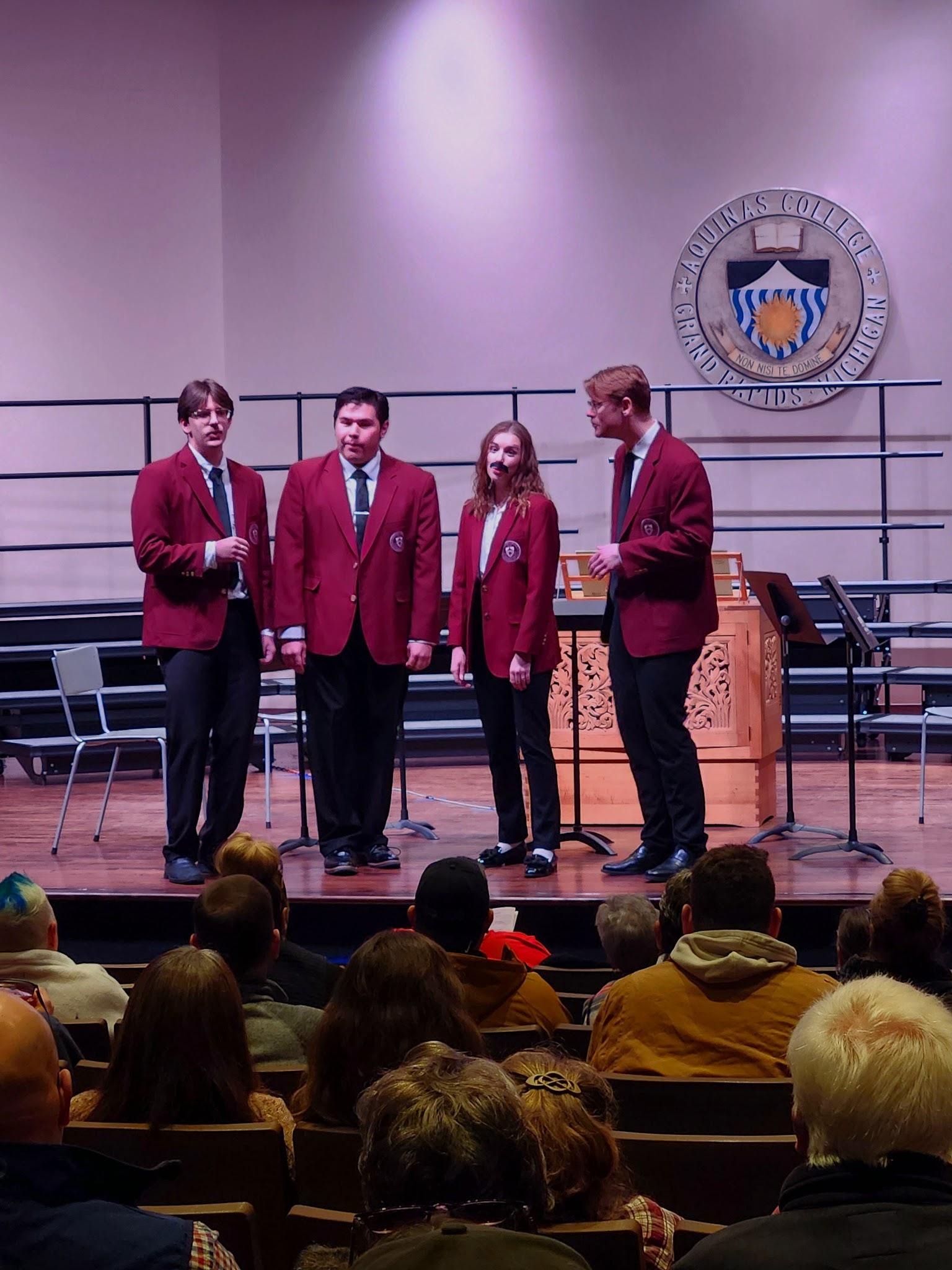
Three and a Half Men singing “Coney Island Baby” – Photo by Nevaeh Porter
The Aquinas Vocal Ensemble, also known as AVE, performed four pieces. They performed “How Sweet It Is” by Lamont Dozier and Brian Holland and arranged by Kirby Shaw, “A Nightingale Sang In Berkeley Square” by Manning Sherwina and arranged by Gene Puerling, “A Gershwin Jazz Trio” by George and Ira Gershwin and arranged by Jay Althouse featuring two soloists, and “Sir Duke” by Stevie Wonder, arranged by Paul Langford. “How Sweet It Is” by Lamont Dozier and Brian Holland is an easygoing swing arrangement of Marvin Gaye’s song that was later made popular by James Taylor is about imagining being loved by someone who hasn’t noticed you yet.
“A Nightingale Sang In Berkeley Square” by Manning Sherwina and arranged by Gene Puerling is a romantic piece that is a British popular song and jazz standard. The song describes a magical night of romance in London’s Mayfair district where a Nightingale sings in the night, even though they are unlikely to appear in central London.
“A Gershwin Jazz Trio” by George and Ira Gershwin and arranged by Jay Althouse has three sections: “Nice Work If You Can Get It” featuring soloist Lauren Espy, “Someone To Watch Over Me” featuring soloist Bri Dells and “I Got Rhythm.” This arrangement is meant for acappella vocal jazz groups and holds tight, tasty harmonies to help them shine.
“Sir Duke” by Stevie Wonder, arranged by Paul Langford takes Wonder’s 1977 hit song at a swing sixteenth groove with tight and rhythmically precise harmonies. This song was intended as an upbeat tribute to jazz bandleader and pianist Duke Ellington who died in 1974.
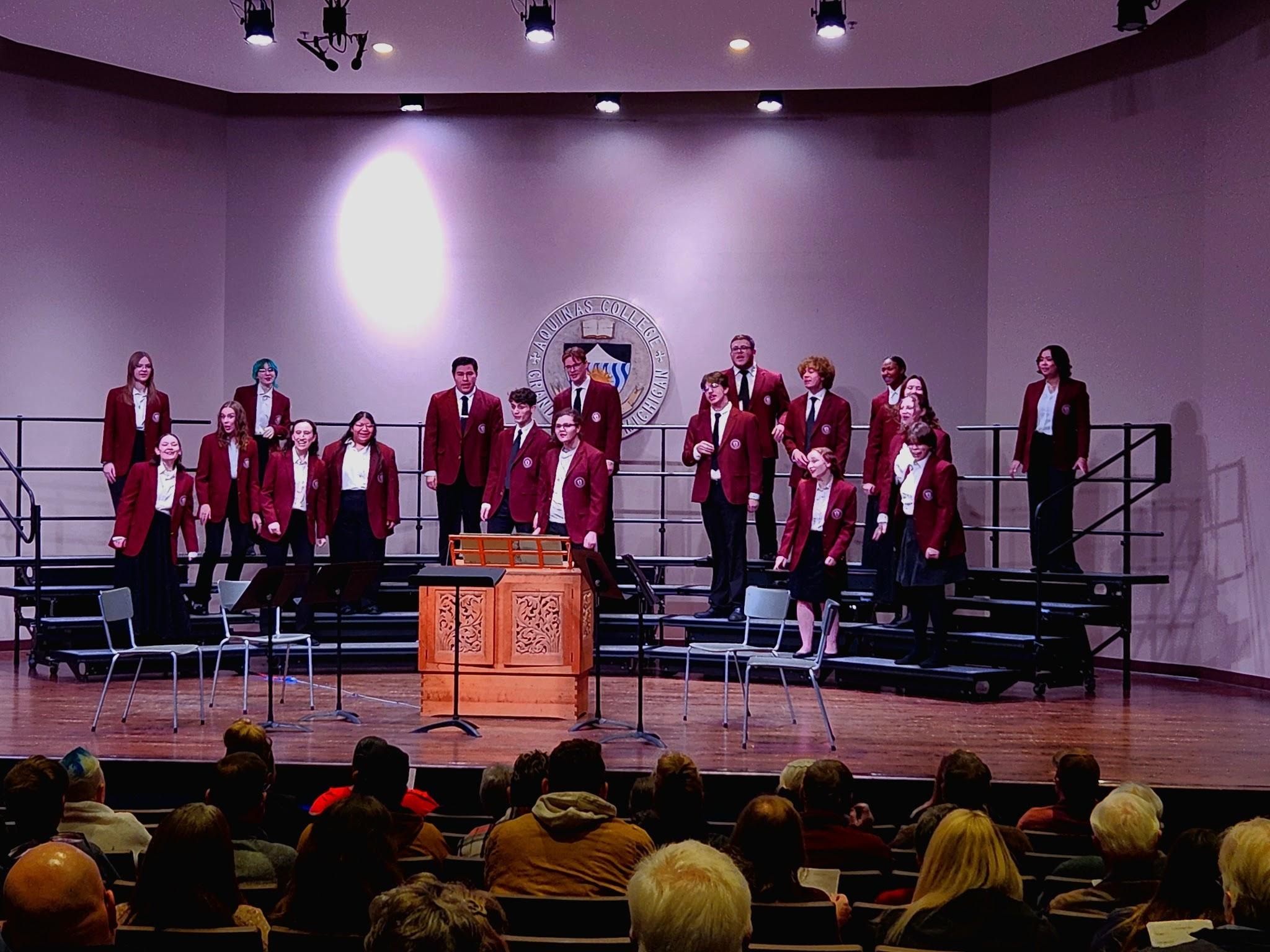
AVE performing “How Sweet It Is” – Photo by Nevaeh Porter
The College Chorus ended the concert with Franz Schubert’s “Mass in G.” The Mass included the “Kyrie”, “Gloria”, “Credo”, “Sanctus”, “Benedictus” and “Agnus Dei.” This piece is a missa brevis that is considered to be a master work. Each section of the mass represents something different and the College Chorus was accompanied by string players, as well as an organist. The instrumentalists were Louisa Blood and Andrew Pool on Violin, Alexander McIntyre on Viola, Josh Zallar on Cello and Dr. Julia Brown on the Portative Organ.
The “Kyrie” represents the plea for mercy. It’s gentle and tuneful, but has a darker solo part before returning to the light. The soloist for this section was Ashlyn Armock.
The “Gloria” is the “Glory Be” or “Glory to God in the Highest.” This section is about praising, thanking and exalting God. The “Gloria” is the bright and triumphant, yet also warm and understated section. Olivia Easler and Memije were the soloists for this section.
The “Credo” is the creed to God, “I believe in one God”, a profession of faith. The “Credo” is a light, hypnotic and flexible, beginning humbly, building up to the climax at the crucifixion, “Crucifixus” and coming back down into a quiet reflection.
The “Sanctus” is an expression of awe, divine holiness and heavenly praise. The “Sanctus” is the “Holy, Holy, Holy.” There’s a brief reverent section that leans into a lively “Osanna” fugue that goes through the ensemble.
The “Benedictus” comes directly after the “Sanctus” and is the “Blessed is he who comes in the name of the Lord” because this follows a warm welcome of Christ entering the mystery of the Eucharist. This movement begins with three solos, then the “Osanna” from the “Sanctus” is sung again at the end of the “Benedictus.” The soloists for this section were Huysentruyt, Spiteri and Vredevelt.
The “Agnus Dei” is a final prayer and plea for both inner and outer peace before communion is taken. This is the “Lamb of God, who taketh away the sins of the world, has mercy on us, grant us peace.” This is a slower deeper section that brings the work as a whole to a close peacefully and prayerfully. The soloists for this section were Mary Kampe and Vredevelt.
“I had the most fun performing the Schubert Mass with the choir because I had solo opportunities and it was fun to sing with the strings and organ,” Vredevelt said. “It’s always fun to sing a master work like that that takes so much time and energy to put together, exclamation mark.”
The concert as a whole showed the diversity in the Aquinas Choirs and what each of them do.
“This concert was definitely one for the books, and I am honored to have been a part of it with such a lovely group of people,” Huysentuyt said.
AVE open for Straight No Chaser at DeVos Place on Nov. 22 at 6:30 p.m. The Chamber Singers next performance will be on Nov. 22 at St. Andrew’s Cathedral, but each of these groups will be singing at Lessons and Carols on Dec. 6 at 3 p.m. in Our Lady Seat of Wisdom Chapel.